
Reviewed · WALKING TOURS
Mahabalipuram walking tour by certified travel company
Mahabalipuram hits fast. In just 2 to 3 hours, you walk through UNESCO Mamallapuram and see Pallava-era rock-cut temples, monolith rathas, and cave shrines, all set along the Bay of Bengal. If you’re the type who wants your first visit to count, this is a very efficient way to get oriented.
What I really like is the certified guide who adds context as you go, so the carvings stop being just pretty stone. I also appreciate that entrance fees are included, which keeps the day smooth and lets you focus on the monuments, not ticket hassles.
The main drawback is the pace. Several stops are timed around 15 to 30 minutes, so if you want slow, lingering time to study every carving in detail, you may wish you had more hours on the ground.
In This Review
- Key Highlights You’ll Feel on This Walk
- A Short, Storied Walk Across Pallava-Era Mahabalipuram
- Price and Value: Why $47 Works Here
- Meet at Shore Temple, Finish at Butter Ball
- Stop-by-Stop: What Each Monument Teaches You
- Stop 1: Shore Temple, Watching the Bay
- Stop 2: Pancha Rathas, The Monolith Chariot Temples
- Stop 3: Arjuna’s Penance, A Bas-Relief Story in Stone
- Stop 4: Krishna’s Butter Ball, The Boulder That Cheats Gravity
- Stop 5: Varaha Cave Temple, Granite Carving With Patience
- Stop 6: Pancha Pandava Cave, Supported Stone and Clear Structure
- Stop 7: Mahishasuramardini Cave, Two Impressive Works
- Stop 8: Ganesh Ratha Temple, A Single-Stone Chariot With a Twist
- Stop 9: Mahabalipuram Lighthouse, A Very Early Light
- Guides Make the Difference, Especially Rajesh and Basha
- Shared vs Private: Choose Based on How You Like to Travel
- A Few Practical Tips So You Get the Full Value
- Should You Book This Mahabalipuram Walking Tour?
Key Highlights You’ll Feel on This Walk
- Paced for time-smart sightseeing: a tight circuit of the biggest 7th-century sights in a short window
- Guide-led meaning-making: you get the stories behind rathas, caves, and reliefs as you move
- Entrance fees are handled: you do not waste time budgeting site by site
- Photo-friendly stops: the route is set up so you can take plenty of pictures without feeling rushed
- Options for comfort: you can stay walking, or mix in a rickshaw when you want a break
A Short, Storied Walk Across Pallava-Era Mahabalipuram

This tour is built for people who arrive with limited time and a big wish list. The route connects the Bay-facing Shore Temple with the sculpted temples and cave complexes that Mahabalipuram is famous for. You’re not trying to see everything in India. You’re seeing the stuff that makes this place feel like a living history lesson in stone.
Also, the structure is practical. You start at the Shore Temple area and finish near Krishna’s Butter Ball, so your walking makes a natural arc through the core cluster of monuments. The tour runs about 2 to 3 hours, which is long enough to feel like you had a real outing, but short enough to work for a day trip from Chennai or any busy itinerary.
One more thing that matters: this is offered as a shared tour or a private upgrade. If you’re traveling with friends, the shared format can stretch value. If you want more flexibility and personalization, go private.
More Walking Tours in Chennai
- Gods of Mylapore walking tour- tourism ministry approved company
★ 5.0 · 267 reviews - Georgetown heritage walking tour in Chennai about the founding of Chennai
★ 5.0 · 144 reviews - Mahabalipuram walking tour by tourism ministry approved company
★ 5.0 · 102 reviews
Price and Value: Why $47 Works Here
At $47 per person, you’re paying for three things that add up quickly on your own: a certified guide, multiple site entrance fees, and an organized route that saves you time figuring out logistics.
If you self-tour, the “hidden cost” is time. You either coordinate tickets and transport yourself or you sacrifice time to repetition, backtracking, and decision fatigue. Here, the route is already stitched together. That matters because Mahabalipuram’s key monuments can be spread out enough that a free-form day can turn into a lot of wandering without strong historical context.
And the reviews point to good guide energy: people mention guides who stay organized, speak good English, and help with practical things like photographs and lunch recommendations. That’s part of the value too, because the carvings make more sense when someone points out what you’re actually looking at.
If you’re booking about a week ahead (on average, 8 days), you’re also usually locking in a good slot, so you’re less likely to be stuck with a timing compromise.
Meet at Shore Temple, Finish at Butter Ball
You’ll meet at Mahabalipuram Shore Temple, Beach Rd. That’s a smart start because Shore Temple sets the stage. It’s big, coastal, and instantly gives you the historical vibe. You’ll end near Krishna’s Butter Ball, E Raja St. Ending there also works well because it’s one of the most memorable “wait, what am I seeing?” stops on the route.
The tour includes a mobile ticket, which is convenient, especially in places where paperwork can feel slow. The meeting point is also described as near public transportation, so you’re not forced into complicated last-mile travel plans.
Finally, the pace is described as suitable for most travelers. I would still plan for sun and walking comfort, since you are moving through outdoor stone sites.
Stop-by-Stop: What Each Monument Teaches You
Below is the tour’s flow, and what to look for at each stop. I’m also noting where the short time can feel limiting, so you can adjust your expectations.
A few more Chennai days to compare
- Chennai Walking Tour ( 2 hours guided tour)
★ 3.8 · 85 reviews - Sowcarpet Street Food Walking Tour in Chennai with guide
★ 5.0 · 83 reviews - Private Bazaar Trail Walking Tour in George Town
★ 5.0 · 66 reviews - British Architecture Walk, an immersive walking tour in Chennai
★ 5.0 · 60 reviews
Stop 1: Shore Temple, Watching the Bay
The Shore Temple overlooks the Bay of Bengal, and it’s tied to the Pallavas, when Mahabalipuram functioned as an important port area. It was built by King Raja Simha in the early Pallava period.
Why this stop matters: it anchors the “why” behind the stone. You see the coastline context first, then the carvings feel less random. You start understanding the place as a political and trade hub, not just a set of monuments.
Potential drawback: it’s about 30 minutes, which is enough for a good overview, but you won’t have hours to study architectural details. If you love architecture, arrive with your camera ready and focus on the coastal views and the temple’s setting.
Stop 2: Pancha Rathas, The Monolith Chariot Temples
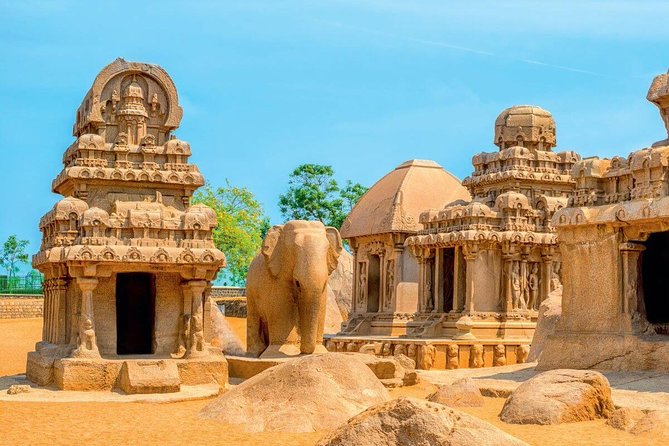
Next come the Pancha Rathas, rock-cut monolith temples from the 7th century. Each ratha is dedicated to figures from the Mahabharata: Draupadi, Arjuna, Nakul-Sahadeva, Bhima, and the remaining figure is part of the set you’ll hear explained on the walk.
What to look for: even in a short visit, you can compare the shapes and how each structure reflects its dedication. The guide’s job here is to connect the symbolism to the stone, so the names become meaningful rather than just labels.
Potential drawback: 30 minutes sounds short because you might want to keep circling for angles. If crowds or heat push you, prioritize one good viewpoint per ratha and let the guide point out key features.
Stop 3: Arjuna’s Penance, A Bas-Relief Story in Stone
Arjuna’s Penance is a bas-relief monument considered one of India’s most magnificent ancient artworks. It depicts Mahabharata scenes and measures about 100 feet long and 45 feet tall.
This is the stop where the guided context really earns its keep. When someone explains what scenes you are seeing and how the composition is organized, you can actually “read” the relief instead of just scanning it.
Potential drawback: at 20 minutes, you’ll likely focus on the most striking sections. That’s fine if you go with the mindset of selecting a few key areas rather than trying to absorb the entire long narrative.
Stop 4: Krishna’s Butter Ball, The Boulder That Cheats Gravity
This stop is famous for a boulder known as Krishna’s Butter Ball. It appears to defy gravity, and it’s said to have stayed in place for more than a thousand years.
Why it works on a walking tour: it breaks the “stone lecture” rhythm. It’s quick, funny in a good way, and it gives your brain a visual puzzle to solve. The guide’s commentary helps you see why the setting matters.
Potential drawback: 15 minutes is exactly long enough for photos and a basic explanation. If you want the slow, hands-on curiosity, you may want extra time after the tour.
Stop 5: Varaha Cave Temple, Granite Carving With Patience
The Varaha Cave Temple is carved from a huge granite piece and dates to the 7th century. The temple is described as taking several decades to complete.
What you’ll feel here: the difference between open-air temples and cave work. In a cave space, the carving has a close-up scale. You also get a sense of labor and time, because the effort behind cave carving is naturally more intense than building something exposed to weather.
Potential drawback: 15 minutes can feel like a teaser. Use it to orient yourself: look for the main carved forms, then rely on the guide’s explanation so you don’t miss the significance.
Stop 6: Pancha Pandava Cave, Supported Stone and Clear Structure
Pancha Pandava Cave is described as the largest cave-temple at Mahabalipuram. It has support elements including six pillars and two pilasters.
Why it’s worth a stop: size changes how you experience a cave. You move from thinking about individual carved details to thinking about structure, layout, and how the space frames the sacred purpose.
Potential drawback: the cave is big, and your time is short at 15 minutes. If you’re sensitive to claustrophobic spaces, take it slow and pause where you feel comfortable.
Stop 7: Mahishasuramardini Cave, Two Impressive Works
The Mahishasuramardini Cave includes two of the most impressive works of Mahabalipuram. Your guide will help you connect what you’re seeing to the story behind it.
Potential drawback: because the tour gives it 15 minutes, you may wish you had more time to compare the two works side by side. Still, it’s a strong “yes, this place deserves UNESCO status” moment.
Stop 8: Ganesh Ratha Temple, A Single-Stone Chariot With a Twist
The Ganesh Ratha Temple is an imposing chariot carved out of a single stone. It was originally dedicated to Lord Shiva, and it later has the deity of Shiva’s son, Lord Ganesh.
What to notice: the “chariot” shape is visual storytelling. Even if you know little about the religious context, you can feel the dramatic intention of the form.
Potential drawback: 15 minutes means you’ll get a guided overview rather than a deep study. If you love iconography, bring your curiosity and ask the guide which details are the must-sees.
Stop 9: Mahabalipuram Lighthouse, A Very Early Light
The last listed stop is the Mahabalipuram Lighthouse, built in 640, described as India’s oldest lighthouse and one of the oldest in the world.
Why it’s a good finish: it brings you back to the coastal story you started with at Shore Temple. It also gives a modern world anchor. You’re not only seeing temple and myth. You’re seeing how the coast mattered for navigation too.
Potential drawback: 15 minutes is mainly for a view and a quick historical note. If you want long lighthouse photographs, you can do that after the tour near the area.
Guides Make the Difference, Especially Rajesh and Basha
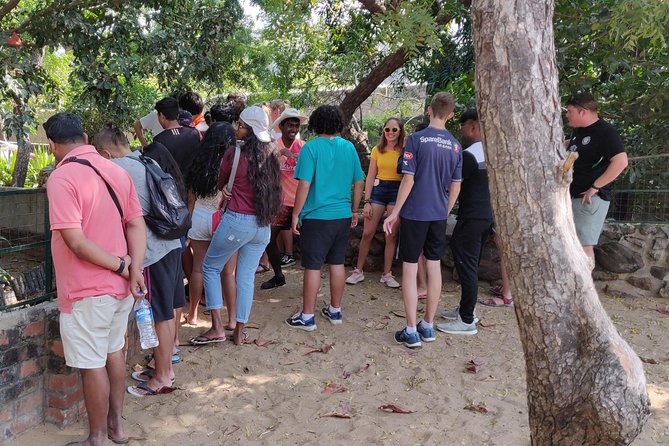
One of the biggest reasons this tour scores so high is simple: people talk about the guides. Two names show up repeatedly, Rajesh and Basha.
Rajesh is credited with great organization and good English, including support for solo travelers, where he made sure the person had a knowledgeable guide and was not left to figure things out. Basha is also mentioned for doing a wonderful job, helping with photographs, and even offering a tuk-tuk ride as an option to see monuments comfortably.
There’s a practical takeaway for you: before you go, think about what you want most from a guide. If you want story and symbolism, pick the tour format where you can ask more questions. If you want photos and smooth pacing, look for guides known for that kind of attention to the group.
Also, lunch comes up in the feedback. People mention that the guide helped steer them toward a local restaurant, including fish curry and a lunch that felt genuinely good. That’s not a small detail. In a day-trip setting, a good meal suggestion can be the difference between a forgettable outing and a strong memory.
Shared vs Private: Choose Based on How You Like to Travel
This experience offers a shared tour option and an upgrade to private. That choice affects your day more than you might think.
- Shared format is often best if you enjoy meeting fellow travelers, and you’re fine moving at a group pace.
- Private is best if you want the guide to slow down for your questions, take extra photos at the stops you care about most, or mix walking with rickshaw time more flexibly.
Because the tour is described as private for your group in the booking details, I’d think of it as more intimate than a big bus-style tour. You still get a planned route and guide context, just with less crowd pressure.
A Few Practical Tips So You Get the Full Value
This isn’t a museum marathon, but it is still an outdoor walk through stone sites. A little planning helps you enjoy the monuments instead of focusing on discomfort.
- Wear comfortable shoes. The route involves repeated short moves between stops.
- Bring sun protection. The tour is outdoors, and the schedule is tight.
- Have your camera ready early. Some of the most photo-friendly moments are among the quickest stops like Butter Ball and the rathas.
- If you’re tired, ask about rickshaw options. The tour overview suggests you can explore by rickshaw in addition to walking.
If your biggest priority is learning, keep your questions ready. A good guide turns carved scenes into something you can actually recognize as you look.
Should You Book This Mahabalipuram Walking Tour?
I think this is a smart booking if you are:
- Going to Mahabalipuram for the first time and want the core monuments in a short time window
- Interested in the carvings and want context from a certified guide instead of just snapping photos
- Trying to keep the day efficient, with entrance fees included and a ready-made route
- Traveling with friends and want a group-friendly walk, or booking private for more personalization
I’d skip or adjust your expectations if:
- You want long, unhurried time at each site. The stops are relatively short, so you’ll be selecting what to focus on.
- You have mobility concerns that require more flexible pacing. The tour says most travelers can participate, but it does not promise specialized assistance.
If you’re spending limited time in Chennai and want a meaningful half-day style experience, this tour is one of the cleaner ways to do it. You leave with a much better mental map of Mahabalipuram, and with the feeling that someone taught you how to look at what you came to see.
Recently added around Chennai
- Wild life tour in Chennai with guide and private car★ 5.0 · 9 reviews
- St Thomas Trail in Chennai by Wonder tours★ 4.5 · 11 reviews
- Exploring Georgetown: A Heritage Walking Tour of Chennai★ 4.5 · 16 reviews
- South India Tour- Temple Architecture and Backwaters★ 5.0 · 7 reviews
- Private Tour: Pondicherry Day Trip from Chennai★ 5.0 · 6 reviews
- Discover Georgetown: Guided Bazaar Walk Through Vibrant Markets★ 5.0 · 9 reviews
- Full-Day Private Tour to the Kanchipuram Temples from Chennai★ 5.0 · 73 reviews
- Chennai City Highlights – Government Museum & Temple Discovery★ 4.0 · 7 reviews
Walking Tours, compared.

The Great Indian Food Tour: Old Delhi Food and Heritage Walk
Read our review →


Old Delhi Food, Heritage&Cultural Walk with Rickshaw ride to Masterji Kee Haveli
Read our review →
Fontainhas Heritage Walk At Latin Quarters of Goa
Read our review →Browse the lists this tour appears in