
Reviewed · HISTORICAL TOURS
The Hipster Chandigarh Architecture History Tour
Brutal concrete, smart planning, and real people watching. This two-day Chandigarh architecture history tour strings together the city’s most famous modernist buildings, plus a few rare access moments, with an insider guide, Rusty. I like that it is not just photos and facts, it is context and stories tied to how Chandigarh actually works.
Two things I really like: you get insider-guided access at major sites like the UNESCO Capitol Complex, and you also visit places that most visitors never reach, including Pierre Jeanneret’s public socialist housing (when local conditions allow). Second, tickets and entrance fees are included, plus photography fees are covered, so you are not doing math all day.
One possible drawback: the itinerary is packed with walking and on-site time, and a few key locations can be affected by local schedules. If your day needs lots of downtime, you may want to plan for quieter breaks and snacks you buy yourself.
In This Review
- Key things to know before you go
- Two days in Chandigarh, built around Corbusier and Jeanneret
- Day 1: UNESCO Capitol Complex to Tower of Shadows
- Stop 1: Capitol Complex, the UNESCO centerpiece
- Stop 2: Le Corbusier Centre, a museum built for learning
- Stop 3: Gandhi Bhawan, Pierre Jeanneret’s signature roof
- Stop 4: Chandigarh Architecture Museum, tied to the Zurich Pavilion
- Stop 5: Open Hand Monument, symbolism you can walk up to
- Stop 6: Geometric Hill, sculptural earth mounds and concrete
- Stop 7: The Tower of Shadows, a solar “demo” building
- Stop 8: Panjab University, big scale beyond the photo
- Stop 9: Museum Maison Jeanneret, Pierre Jeanneret’s early home
- Day 2: Sukhna Lake, Sector 17 life, and rare housing access
- Stop 1: Sukhna Lake, Corbusier’s water and climate idea
- Stop 2: Sector 17 Market, Corbusier’s commercial grid in real life
- Stop 3: Chandigarh War Memorial, architecture in a garden
- Stop 4: Public socialist housing by Pierre Jeanneret, rare access (subject to conditions)
- Stop 5: Government Museum and Art Gallery, Le Corbusier’s museum and pre-partition artifacts
- Stop 6: Lake Club, a lesser-known Corbusier-linked private space
- What makes the guide matter, and how to get the most from it
- Price and value: why $71.02 can work here
- Who should book this (and who might want a different fit)
- A few practical tips before your first 9:00 am
- Should you book this Hipster Chandigarh Architecture History Tour?
- FAQ
- How long is the Hipster Chandigarh Architecture History Tour?
- What does the tour cost per person?
- What is included in the tour price?
- Do I need separate tickets for museums and monuments?
- What time does the tour start?
- What if weather is bad?
- Is there a cancellation refund window?
Key things to know before you go
- UNESCO at the Capitol Complex plus multiple Le Corbusier and Pierre Jeanneret-linked stops in one day
- Tickets and admission are included, including photography ticket/fees
- Pickup and AC vehicle with parking, waiting, and drop charges covered
- A small-ish group up to 41 people, led by Rusty with personal local knowledge
- A rare housing access stop on Day 2, subject to local variables
- Two full days starting at 9:00 am, so wear comfortable shoes and plan for long site time
Two days in Chandigarh, built around Corbusier and Jeanneret
Chandigarh is famous for architecture, but it is really a system: design choices that affect heat, shade, movement, and community life. This tour makes you see that system. It starts at the core government complex, then moves outward to museums, campuses, markets, parks, and water.
The rhythm is intentional. Day 1 leans heavy on the Capitol Complex era and the idea of modernism as practical design. Day 2 balances that with everyday Chandigarh: a lake walk, a commercial sector, a memorial space, and cultural collections inside a Le Corbusier-designed museum.
You start at 9:00 am and the tour runs about 2 days. You ride in an air-conditioned vehicle with pickup and drop included, and parking and waiting are covered, which matters in a city where stops can take time. You also get a mobile ticket. Good for you, because you spend less energy on logistics and more on the buildings.
A few more Chandigarh days to compare
- Fontainhas Heritage Walk by Make It Happen
★ 5.0 · 2,834 reviews - The Great Indian Food Tour: Old Delhi Food and Heritage Walk
★ 5.0 · 1,698 reviews - Old Goa Heritage Walk by Make It Happen
★ 5.0 · 797 reviews
Day 1: UNESCO Capitol Complex to Tower of Shadows
Day 1 is where the tour teaches you how Chandigarh thinks in geometry and concrete. Expect frequent guided time inside or directly at the buildings, with enough pause time for photos and a snack stop when you need it.
Stop 1: Capitol Complex, the UNESCO centerpiece
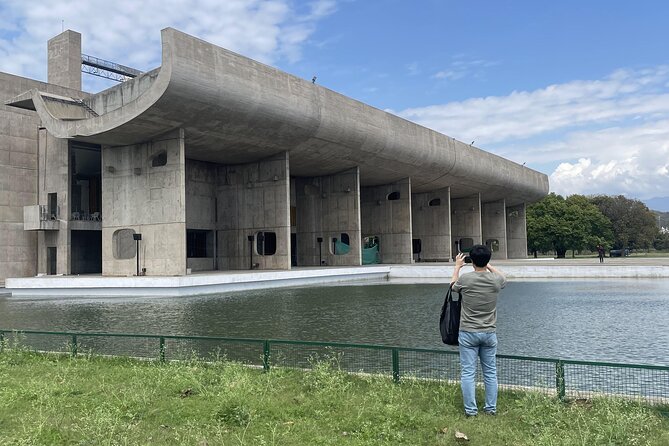
This is the headline. You get insider-guided access to the UNESCO Capitol Complex, including the Secretariat, the Assembly Hall, and the Open Hand Monument. The buildings here show brutalist concrete forms and the big-picture planning Le Corbusier helped shape for Chandigarh.
What you will notice fast is how the site works as a whole, not as separate monuments. The views and alignments matter, and Rusty’s storytelling helps you connect the symbolism to the physical layout.
Stop 2: Le Corbusier Centre, a museum built for learning
Next is the Le Corbusier Centre, an older architects building that now functions as a museum and memorial center. You will see a guided tour with visual demonstrations related to an early attempt at sustainability, including natural cooling ideas.
This stop works well if you learn best when architecture is explained like a problem-solver. You do not just hear what the building looks like. You hear what it was trying to do.
A small consideration: it is a museum-style environment. If you prefer outdoor viewing only, you may find you want more time outside after this.
Another way to spend a day in India:
- Full Day Private Agra Tour from Delhi by Car
★ 5.0 · 41 reviews - Private 7 Days Shimla Manali Hill Stations Tour From Chandigarh
★ 5.0 · 30 reviews - Golden Triangle 6 Days
★ 5.0 · 22 reviews - Golden Triangle 3 Days
★ 4.5 · 15 reviews
Stop 3: Gandhi Bhawan, Pierre Jeanneret’s signature roof
At Gandhi Bhawan, you visit the heart of the university, with guided access to a structure designed by Pierre Jeanneret. The highlight is the distinctive lotus-shaped spinning roof, which makes this building visually dramatic and also tied to the city’s climate challenges.
The best part is the way this stop connects architecture to atmosphere. You get to see how form and function meet. And because it is at a functioning university space, the energy feels more real than a purely formal monument site.
Stop 4: Chandigarh Architecture Museum, tied to the Zurich Pavilion
Then you move to the Chandigarh Architecture Museum, which acts like an homage to Le Corbusier’s 1965 Zurich Pavilion. You are guided through three levels of exhibits and rare displays.
This is a useful bridge stop. By the time you reach it, you have seen iconic forms outside. Now you can connect them to design thinking, models, and the lineage of ideas.
Stop 5: Open Hand Monument, symbolism you can walk up to
The Open Hand Monument is the crowning symbol of Chandigarh, created as a message of peace and unity and part of the UNESCO story. You get insider access close enough to really study the monument’s presence and how it fits the surrounding complex.
On a breezy day, the feel is extra. The tour description even hints that the wind can make the experience more memorable.
Stop 6: Geometric Hill, sculptural earth mounds and concrete
Next is Geometric Hill, a designed landscape within the Capitol Complex area. You will get personalized guided access through the grid-like earth mounds and concrete forms.
This stop is for people who love structure details. It is less about a single building and more about how terrain and geometry shape movement and views.
Stop 7: The Tower of Shadows, a solar “demo” building
Then comes The Tower of Shadows, an open-air concrete structure designed by Le Corbusier as a demonstration building to study the sun’s movement. The central idea here is sunlight as a design tool.
Even if you are not a lighting nerd, you will get why this matters. Shadows are not random here. They are part of how the building teaches you.
A consideration: because it is about the sun and shadows, it is more rewarding when weather and light are cooperative.
Stop 8: Panjab University, big scale beyond the photo
You continue at Panjab University, with guided insider time. This helps you see Chandigarh modernism not just as government branding, but as an approach to education and civic identity.
This stop also gives you a break from the tight concentration of the Capitol Complex. It feels like a different side of the city’s priorities.
Stop 9: Museum Maison Jeanneret, Pierre Jeanneret’s early home
Day 1 ends at Museum Maison Jeanneret, the first house built in Chandigarh. It was the residence of Pierre Jeanneret for 11 years and now functions as a museum.
If you want to understand the human scale behind the grand designs, this is the stop. You learn how the architects lived inside the work, not just outside it.
Day 2: Sukhna Lake, Sector 17 life, and rare housing access
Day 2 shifts from pure landmark mode to a broader city read. You still get guided time with architecture connections, but the stops also include how Chandigarh breathes in daily life.
Stop 1: Sukhna Lake, Corbusier’s water and climate idea
You start with a gentle walk at Sukhna Lake, a manmade lake designed by Corbusier. The tour frames it as a way to refresh groundwater and cool northern sectors of the city.
Even with a quick stroll, you will feel why water design matters in this kind of climate planning. This is architecture that treats comfort like a civic responsibility.
Bring your eyes, not just your camera. The “why” of the lake is the point.
Stop 2: Sector 17 Market, Corbusier’s commercial grid in real life
At Sector 17 Market, you walk and talk through the often-ignored commercial designs in the city center. Expect shaded tree-lined walkways and plenty of people watching.
This is a great contrast to the monumental buildings from Day 1. It reminds you that Chandigarh’s planning is not only about halls and monuments. It is about sidewalks, shade, and everyday movement.
Stop 3: Chandigarh War Memorial, architecture in a garden
Next is the Chandigarh War Memorial, a solemn tribute park within the Bougainvillea Garden of Sector 3. You will learn how architectural subtlety and historical resonance meet in a space meant for reflection.
If you care about how design handles emotion and memory, this stop lands. It is not just pretty. It is respectful and thoughtful in its setting.
Stop 4: Public socialist housing by Pierre Jeanneret, rare access (subject to conditions)
One of the most compelling parts of the tour is the rare access stop: Pierre Jeanneret’s public socialist housing. The description notes that access is private and guided and that it is still functional in its original stance, but it depends on local variables.
This is where the “history tour” label becomes real. You see modernist planning applied to daily housing, not just government symbolism.
Since this access is condition-based, do not plan your entire emotion around it. But if you do get in, it is a memorable window into how Chandigarh was built for people.
Stop 5: Government Museum and Art Gallery, Le Corbusier’s museum and pre-partition artifacts
Then you visit the Government Museum and Art Gallery, a 1960s heritage museum designed by Le Corbusier. Inside, you will find pre-partition-era artifacts from Pakistan, including one of the world’s largest collections of Greco-Buddhist art.
This stop broadens the tour beyond architecture into culture and historical context. It is especially valuable if you want to understand Chandigarh as a place that holds multiple narratives, not just a single design movement.
Stop 6: Lake Club, a lesser-known Corbusier-linked private space
The last stop is the Lake Club, described as an often-ignored private yacht club for recreational boating and socializing, designed by Corbusier about a year before his death.
Even though it is private-focused, you still get an insider guided tour. The architectural design is the key, so you will be looking at how social spaces get shaped by the same design logic as civic buildings.
This makes a good ending because it shows how Chandigarh’s planning reaches into leisure and community.
What makes the guide matter, and how to get the most from it
Rusty is a third generation Chandigarh citizen who has lived inside Corbus’s public social housing, studied in schools designed by Pierre, and worked in offices designed by Maxwell Fry. That personal connection is why the tour does not feel like a script.
From the reviews, the big themes are clear. Rusty brings humor with politically neutral care, which is useful in mixed groups. He also adjusts when plans change, including when sites close unexpectedly due to a public holiday. And he pays attention to pacing and snack stops based on what you prefer.
You should come ready to ask questions. The tour works best when you treat it like a conversation. If you are the type who notices shade angles, courtyard placements, or how people actually move through a sector, you will get even more out of the guided explanations.
Also, remember that you are paying for included admissions and photography-related fees, so you can spend your energy on viewpoints instead of ticket booths.
Price and value: why $71.02 can work here
At $71.02 per person for a two-day experience, the value depends on how much you would normally spend on entry tickets, local transport, and guided access. In this case, the price is backed by a few important inclusions:
- AC vehicle with pickup and drop, plus parking and waiting charges covered
- Admission fees included for all listed stops
- Entrance fee coverage including photography tickets and fees
- Stops that are guided with insider access, including UNESCO areas and museum admissions
What you will pay extra for is mainly personal snacks and optional gratuities. That is typical, but it is nice that the tour notes snack stops are cheap, so you can keep your budget under control.
The best value sign is that multiple stops include guided entry time, not just exterior viewing.
Who should book this (and who might want a different fit)
This tour is a strong match for you if you:
- like modernist architecture and want the big ideas explained in human terms
- want a citywide plan, not just one highlight
- enjoy a humorous guide who balances stories with facts
- appreciate insider access, especially rare spots tied to how people live
It may not be ideal if you:
- want a fully slow pace with lots of free time
- dislike walking and on-site guidance
- need full certainty that every access point will open, since at least one rare access item is subject to local variables
A few practical tips before your first 9:00 am
- Wear comfortable shoes. You are moving through several sites over two full days.
- Expect sun. Bring water and something light to cover your head, especially for open-air stops like the Tower of Shadows area.
- Plan for snacks you buy yourself. They are cheap, but they are not included.
- Bring your photo habits. Since photography ticket and fees are covered, you can focus on taking pictures without worrying about small add-on charges.
Should you book this Hipster Chandigarh Architecture History Tour?
Yes, if you want a guided, well-paced modernist city tour with real access and a guide who connects design to lived experience. The combination of UNESCO Capitol Complex insider time, museums tied to Le Corbusier and Pierre Jeanneret, plus a rare housing access stop is hard to replicate on your own.
Book it especially if you like your architecture with context, shade, movement, and daily life woven into the story. If you have limited time in Chandigarh and you want the best-known buildings plus smart extras, this two-day format gives you that without turning your trip into a ticket-juggling exercise.
FAQ
How long is the Hipster Chandigarh Architecture History Tour?
It runs for 2 days (approximately).
What does the tour cost per person?
The price is $71.02 per person.
What is included in the tour price?
Pickup and drop charges, parking fees, an air-conditioned vehicle, entrance fees (including photography tickets and fees), and admission fees for all included stops are covered.
Do I need separate tickets for museums and monuments?
No. Admission fees and entrance fees at the listed stops are included, and a mobile ticket is provided.
What time does the tour start?
The start time is 9:00 am.
What if weather is bad?
The experience requires good weather. If it is canceled due to poor weather, you will be offered a different date or a full refund.
Is there a cancellation refund window?
You can cancel up to 6 days in advance for a full refund. Cancel 2 to 6 days before for a 50% refund, and cancel less than 2 days before for no refund.
Recently added around Chandigarh
- Taj Mahal Sunrise Tour from Delhi★ 5.0 · 9 reviews
- Best Taj Mahal Tour From Delhi★ 5.0 · 6 reviews
- Taj Mahal Sunrise Tour from Delhi★ 5.0 · 6 reviews
- Golden Triangle 3 Days★ 4.5 · 15 reviews
- Private 6 Days Shimla Kullu Manali Tour From Chandigarh★ 5.0 · 8 reviews
- Highlights of the Chandigarh (Guided Half Day City Tour)★ 4.5 · 7 reviews
- 5 Day Golden Tingle Luxury Private Tour with Guide★ 5.0 · 10 reviews
- Affordable Chandigarh to Manali Transfer★ 5.0 · 11 reviews
Historical Tours, compared.
The Great Indian Food Tour: Old Delhi Food and Heritage Walk
Read our review →
Old Delhi Food, Heritage&Cultural Walk with Rickshaw ride to Masterji Kee Haveli
Read our review →
Fontainhas Heritage Walk At Latin Quarters of Goa
Read our review →
Blue City Heritage Private Walking Tour With Pickup and Drop-Off
Read our review →
Private Heritage Walking Tour in Jaisalmer Fort and Old Bazaar
Read our review →Browse the lists this tour appears in