
Reviewed · MORNING
The Mumbai by Dawn Early Morning Tour
Waking up early changes Mumbai fast. I like that this tour hits working markets and real waterfront life before most visitors show up, and I like that the guide helps you read what you’re seeing. One thing to consider: the “dawn” part is serious, and the stops are active, practical places, not polished sightseeing.
You’ll spend about three hours with an English speaking guide, plus hotel pickup and drop off in an air-conditioned vehicle. The schedule is tight by design, so you get a focused sample of Mumbai’s day before traffic and crowds shift the mood. The value is especially good for a small group, since the price is per group up to 4.
Here’s the vibe: you’re watching people work, buy, grade, scrub, and sell, and you get context for it. Expect early light, strong smells near food and laundry, and photo moments that feel earned, not staged.
In This Review
- Key highlights worth getting up for
- A dawn start that changes how you see Mumbai
- Chhatrapati Shivaji Terminus, morning architecture with huge foot traffic
- Sassoon Dock fish auction and Koli fisherfolk life
- BB Dadar Market, colors and fragrances before the day crowd
- Dhobi Ghat, watching washermen work at scale
- How the 3-hour private format fits your day
- Price and value for an early-morning small group
- Should you book The Mumbai by Dawn Early Morning Tour?
- FAQ
- How much does The Mumbai by Dawn Early Morning Tour cost?
- How long is the tour?
- Is hotel pickup and drop-off included?
- Is this tour private?
- Are admission tickets required for the stops?
- Is there a mobile ticket and when do I get confirmation?
- What is the cancellation policy?
Key highlights worth getting up for
- Chhatrapati Shivaji Terminus at morning pace, with the station’s massive daily footfall in context
- Sassoon Dock fish auction, including Bombay duck and the scale of fish grading
- BB Dadar Market senses, where early colors and fragrances set the tone
- Dhobi Ghat at industrial scale, with thousands of washermen and huge daily volumes of clothes
- A small private group, so your guide can keep the flow personal
- Included pickup, A/C transport, coffee or tea, and bottled water, so you start the day without hassle
A dawn start that changes how you see Mumbai

This is one of those tours where the timing is the whole point. Mumbai at daybreak feels like a different city than Mumbai at noon. You see setup in motion, not just the finished product. It also means you spend less time fighting crowds and more time understanding how the city runs.
You’re getting four stops along major Mumbai working areas, moving steadily by car between them. Each stop is short enough to keep energy up, but long enough to actually watch what’s happening. And because it’s guided, you’re not just photographing busy scenes, you’re learning what they mean.
Practical reality check: you’ll likely need to be ready early. The tour is about three hours total, so if you drift into the day slowly, you might feel rushed. If you enjoy street-level observation and don’t mind getting close to real work, you’ll love the payoff.
A few more Mumbai days to compare
- Dharavi slum tour in Mumbai by Female tour guides of the slum
★ 5.0 · 1,976 reviews - Mumbai: Full-Day Sightseeing Tour of Mumbai
★ 4.9 · 1,822 reviews - Private Mumbai Sightseeing Tour (Traveller’s Choice Award Winner)
★ 5.0 · 1,565 reviews
Chhatrapati Shivaji Terminus, morning architecture with huge foot traffic
Your first stop is Chhatrapati Shivaji Terminus, also known as CST. This is a major rail station, and it’s also one of India’s most eye-catching examples of station architecture. It matters that you’re arriving early, because you’ll be able to take in the building while the flow is still forming.
The station’s scale is part of the story. CST sees around 660,000 footfalls daily, and that number is not just trivia. It’s a clue to why the station feels like a living machine. People stream in, out, and through, and you start to understand Mumbai as a city of movement.
What I like about starting here on this tour is that it sets a baseline. Before you hit markets and docks, you see a landmark of infrastructure that supports the whole city. It’s also a gentle intro stop. You get about an hour here, with no admission cost required.
What to watch for, practically:
- Look up at the building details and edges, not just the trains.
- Pay attention to how foot traffic moves around entrances and platforms.
- If you like photos, this is a better moment for steadier light than later in the day.
A small consideration: rail stations are busy by nature. If you’re sensitive to crowds or want a quiet photo bubble, you may find it a bit lively even at dawn.
Sassoon Dock fish auction and Koli fisherfolk life
Next up is Sassoon Dock, where the tour shifts from architecture to the waterfront economy. You’ll learn about the Koli fisherfolk, described here as the original inhabitants of Mumbai. That framing matters, because it keeps the dock from feeling like a generic seafood photo stop.
This stop has a clear sense of scale. You’ll see the arrival and grading of 50 tonnes of fish, plus a fish auction known for Bombay duck. For many visitors, auctions feel like a spectacle. Here, it’s also practical logistics. You’re witnessing how seafood moves from catch to buyers.
Expect this to be the most energetic stop. You’re in active trading territory, and the grading process is visual. You might notice how people handle fish, how lots are organized, and how quickly decisions get made.
A note on your senses: docks can bring strong smells and salty air. That’s normal. If you’re trying to time fragrance and perfume selfies, this isn’t that kind of stop. If you want the real working rhythm of Mumbai’s food system, it’s exactly right.
Time is about 30 minutes, and that’s enough to see the auction setup and the flow without burning the whole morning here. If you want more, you could always follow up later, but this tour gives you the essentials in a manageable time block.
BB Dadar Market, colors and fragrances before the day crowd
Then it’s onto BB Dadar Market, where the tone shifts again. This stop is about atmosphere: early morning color and fragrance. You get a calmer entry than the dock, but it’s still a working market, meaning the energy is human and immediate.
This is one of the stops I think works especially well for first-time visitors who want more than one flavor of “local.” You’re not just seeing food ingredients. You’re seeing how people gather when the day is still quiet. The guide’s role is helpful here, because markets can otherwise feel like a blur of stalls and items.
Time here is also about 30 minutes, and that matters. Markets can pull you in. With a set time, you can focus on a few questions: What looks like the early best sellers? What’s being prepped right away? How do sellers interact with early buyers?
Possible drawback: markets are visually busy, and if you want wide, scenic views, you may feel more in close-up mode. Bring your patience, not your expectations of a museum-like pace.
If you’re sensitive to standing for short bursts, this is probably fine, since you’re not stuck for hours. Just plan on moving with the group and using what you learn to guide what you look at.
Another way to spend a day in India:
- Elephanta Caves & Island Guided Private Tour
★ 5.0 · 1,327 reviews - Group Guided Walking Tour in Fort and Colaba
★ 5.0 · 1,073 reviews - Mumbai: Elephanta Caves Half-Day Guided Tour with Expert
★ 4.8 · 1,032 reviews - Highlights of Mumbai Sightseeing Tour: TRAVELLERS CHOICE AWARDED
★ 5.0 · 915 reviews
Dhobi Ghat, watching washermen work at scale

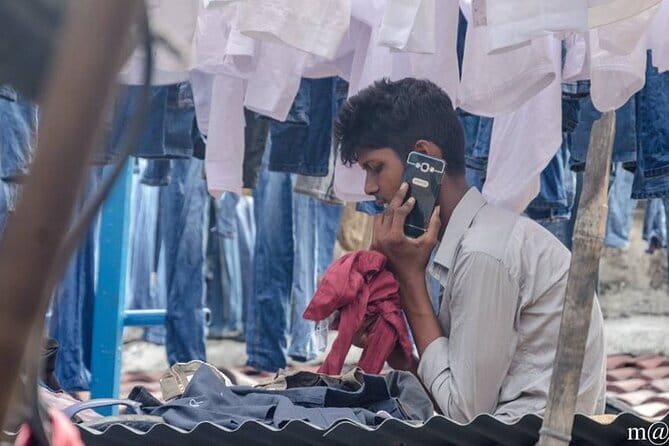
The final major stop is Dhobi Ghat, and it’s the one that often leaves people silent in the best way. This is where thousands of dhobis, or washermen, scrub, flog, wash, and bleach clothes in open concrete wash pens.
The scale is staggering, and the tour data gives numbers that help you take it in properly. More than 7,000 dhobis wash more than 100,000 clothes every day. When you understand the volume, the place stops being just a “scene” and becomes an actual system. It’s labor powered by routine, skill, and repetition.
This stop is about an hour, which is the right length. You’ll have time to watch the steps and notice patterns, not just glance and move on. The guide helps you make sense of what you’re seeing, especially because Dhobi Ghat can feel chaotic to someone unfamiliar with the workflow.
Respect note, since this is real work: keep your distance when asked, avoid blocking paths, and treat people as people, not content. If you do that, the experience can feel surprisingly personal, even though it’s not a formal conversation.
Sensory reality: expect damp air, soap smells, and loud motion from washing. If you’re carrying a camera and want good shots, aim for moments where the action is clear, not when people are turning or moving through tight spaces.
This is also one of the most moving stops because it’s so unmistakably functional. You’re seeing services that keep a city running, in plain sight.
How the 3-hour private format fits your day
The whole tour runs about 3 hours, which is a sweet spot. Long enough to hit distinct working areas, short enough to still use the rest of your day for sights with more downtime.
It’s private, meaning only your group participates. Your group can be up to 4 people, and that small size changes how the guide can handle questions and timing. It also makes the experience feel less like a bus tour and more like a guided morning walk, just with car transfers.
Transport is practical too. You get hotel pickup and drop off, plus an air-conditioned vehicle between stops. That matters in Mumbai. Even if the morning is cool, you’re moving from close-contact environments to car comfort, and that rhythm keeps your energy up.
Included refreshers are also real value, not fluff:
- Coffee and/or tea
- Bottled water
You’re also given a mobile ticket, so you don’t have to worry about printed passes.
One more scheduling angle: since the stops are short and active, the tour works best when you treat it like your main morning activity. If you stack it with another “must-see,” you may feel rushed. I’d plan it as the anchor for the morning, then build in an easier follow-up.
Price and value for an early-morning small group
The price is $199.30 per group for up to 4 people. That pricing structure is the key detail. If you’re traveling solo, you’ll pay the full group rate, and it may feel steep compared to a DIY plan. But if you’re traveling with even two or three people, it starts to look like you’re effectively paying for:
- an English speaking guide,
- A/C transport,
- hotel pickup and drop off,
- coffee or tea,
- bottled water,
- and organized access to working city areas at the right time.
Also, the stops listed have admission tickets free, so you’re not adding extra entrance fees during the morning.
My practical take: the tour is worth it when you want two things at once. You want the early access, and you want context. If you go on your own, you might still see these places, but you’ll spend more time guessing. With a guide, your time in each stop stays purposeful.
The possible tradeoff is simple. You’re paying for structure. If you prefer slow wandering with no itinerary pressure, a fixed 3-hour plan might feel limiting. But if you’re the type who likes to see a lot with a plan, this fits your style.
Should you book The Mumbai by Dawn Early Morning Tour?

Book it if you want a morning in Mumbai that feels real, not rehearsed. I’d especially recommend it if you like:
- street-level observation,
- understanding how food and laundry systems work,
- and getting a quick, guided hit of multiple neighborhoods in a few hours.
Skip it or think twice if you strongly dislike early mornings. This is also not a quiet, sit-and-stare tour. You’ll be in active working areas, and you’ll need to handle smells, movement, and people-focused environments with patience.
If you’re traveling with up to three other people, the group pricing makes it easier to justify. And if you want a guide who can explain what you’re looking at while you’re still in the right time window, this is the kind of tour that does that best.
FAQ
How much does The Mumbai by Dawn Early Morning Tour cost?
It costs $199.30 per group (up to 4 people).
How long is the tour?
The tour lasts about 3 hours.
Is hotel pickup and drop-off included?
Yes. Hotel pickup and drop-off are included, and you travel in an air-conditioned vehicle.
Is this tour private?
Yes. It’s a private tour/activity, and only your group participates.
Are admission tickets required for the stops?
The stops listed in the itinerary show free admission (including Chhatrapati Shivaji Terminus, Sassoon Dock, BB Dadar Market, and Dhobi Ghat).
Is there a mobile ticket and when do I get confirmation?
Yes, the tour uses a mobile ticket, and you’ll receive confirmation at the time of booking.
What is the cancellation policy?
You can cancel for a full refund up to 24 hours in advance of the experience’s start time. If you cancel less than 24 hours before, the amount paid is not refunded.
Recently added around Mumbai
- Mumbai Spice Markets and Bazaars Tour with Guide and Transport★ 5.0 · 42 reviews
- Customize private tour with pickup★ 5.0 · 95 reviews
- Private Guided Bandra Half Day City Tour in AC Vehicle★ 5.0 · 72 reviews
- Mumbai 800 Year Worli Village: Talking Goddess, Old Fort & more★ 5.0 · 94 reviews
- Private Walking Tour in Dharavi Slums★ 5.0 · 7 reviews
- Mumbai by Night Guided Tour★ 5.0 · 6 reviews
- Gufran’s Slum Home Tour in the Mumbai Slums★ 5.0 · 19 reviews
- The Panoramic Ridge Hike near Mumbai★ 5.0 · 7 reviews
Morning, compared.


Sunrise Taj Mahal, Agra Fort & Baby Taj Tour from Delhi by Car
Read our review →
Taj Mahal Sunrise, Baby Taj & Agra Fort Day Tour
Read our review →
Private Sunrise Taj Mahal Trip from Delhi all Inclusive
Read our review →
Private Taj Mahal Sunrise, Baby Taj & Fort Tour
Read our review →