
Reviewed · GOLDEN TRIANGLE TOURS
Private Golden Triangle Tour of India
Delhi to Jaipur in three days is a fast hit of India. This private Golden Triangle tour strings together Delhi, Agra, and Jaipur with a plan that does the heavy lifting for you: transport, guides, and monument entrance fees are built in. I also like the practical hotel option, you can choose 4-star or 5-star accommodations with daily breakfast, so you start each day ready to go.
The main tradeoff is time and driving. You’ll be on the road between cities (and doing an early start for the Taj Mahal), so if you hate long transfers, you may feel it in your legs and patience.
In This Review
- Key things that make this tour work
- Golden Triangle in three days, why it feels so efficient
- Delhi starts with Mughal grandeur at Humayun’s Tomb
- Qutub Minar and the Lotus Temple, two very different moods
- Rajpath area monuments, a quick look inside the political center
- How the Agra transfer sets up your sunrise Taj Mahal
- Agra Fort: the Mughal power base beyond the postcard
- Jaipur arrives after the long drive, and it hits fast
- Jal Mahal photo stop, short and oddly satisfying
- Hawa Mahal and the City Palace, Jaipur’s royal show
- Jantar Mantar Observatory, geometry with a purpose
- Private logistics that matter: timing, guides, and comfort
- Price and value: what $412 includes, and what you’ll still pay
- Who should book this tour
- Should you book it? My decision guide
- FAQ
- What cities are included in this Golden Triangle tour?
- How long is the tour?
- Is pickup included, and what time does it start?
- What does the price include?
- Are lunch and dinner included?
- Can I choose between 4-star and 5-star hotels?
- Are the monument entrance fees included?
- Is Lotus Temple open on all days?
- Is this tour private or shared?
- What is the cancellation policy?
Key things that make this tour work
- Private driver, air-conditioned car keeps long city-to-city days manageable
- Entrance fees included for the major UNESCO sites, so you avoid ticket chaos
- Sunrise Taj Mahal with a return ride from parking via battery bus or golf cart
- Local guides arranged by the company for each day’s cluster of sights
- Hotel choice and breakfast included so food is less of a puzzle
- Free stops and photo stops help you balance sightseeing with downtime
Golden Triangle in three days, why it feels so efficient
The Golden Triangle is famous for a reason, Delhi sets the stage with Mughal and imperial sites, Agra delivers the Taj Mahal, and Jaipur shows you Rajasthan style at full volume. What makes this version stand out is the pacing: you don’t just “see landmarks,” you move in a logical route that reduces backtracking and wasted time.
You also get a built-in structure for day flow. Mornings are for the big outdoor sights (and in Agra’s case, a sunrise slot). Afternoons shift to travel and check-in. That rhythm matters in India, where traffic, security lines, and crowd flow can easily stretch your day if you are improvising.
And because this is a private tour, you’re not waiting for the slowest person in a shared group. If you want photos, you get a real photo stop. If you need a bathroom break, you can ask. Those small freedoms are the difference between a trip that feels planned and one that feels stressful.
Golden Triangle tours readers book most in New Delhi:
- 3-Days Private Golden Triangle Tour: Delhi, Agra & Jaipur by Car
★ 5.0 · 1,107 reviews - 3-Days Private Golden Triangle Tour: Delhi, Agra & Jaipur by Car
★ 5.0 · 1,098 reviews - 3-Day Delhi, Agra and Jaipur Private Tour – India Golden Triangle
★ 5.0 · 812 reviews
Delhi starts with Mughal grandeur at Humayun’s Tomb
Your day in Delhi begins with Humayun’s Tomb, a UNESCO World Heritage site and one of the finest examples of early Mughal architecture in India. It’s not just pretty. The layout and symmetry help you understand how Mughal rulers used design to project power and permanence.
This stop is practical because it gets you into the “big sight” mood fast, without immediately tossing you into a million tiny lanes. Admission is included, and it’s timed so you can still keep momentum through the rest of the day.
One reason I like leading with Humayun’s Tomb is that it sets context for what comes next. After you see Mughal stonework and gardens, Qutub Minar and Delhi’s other monuments make more sense, not less.
Qutub Minar and the Lotus Temple, two very different moods
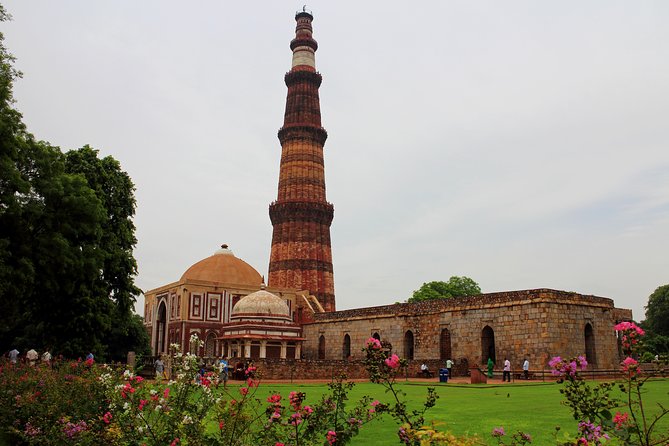
After Humayun’s Tomb, you head to Qutub Minar, another UNESCO site. This is the soaring Afghan-style victory tower and minaret complex, started in 1193 under sultan Qutb-ud-din to proclaim supremacy after the clashes with the rulers of Qila Rai Pithora. The scale hits you quickly, and it’s the kind of landmark where your brain goes, okay, this city has history stacked on history.
Then comes a palate cleanser: Lotus Temple. It’s designed for calm worship and silent meditation, with 27 marble-like petals forming the lotus shape. Admission is free, and the vibe is a real break from the noise outside. Important note: Lotus Temple is closed on Mondays, so if your dates land on a Monday, plan for that.
If you like variety, this pairing works. You get imperial grandeur, then quiet. Most first-time Delhi days skip that quiet moment, but you’re explicitly given it here.
Rajpath area monuments, a quick look inside the political center
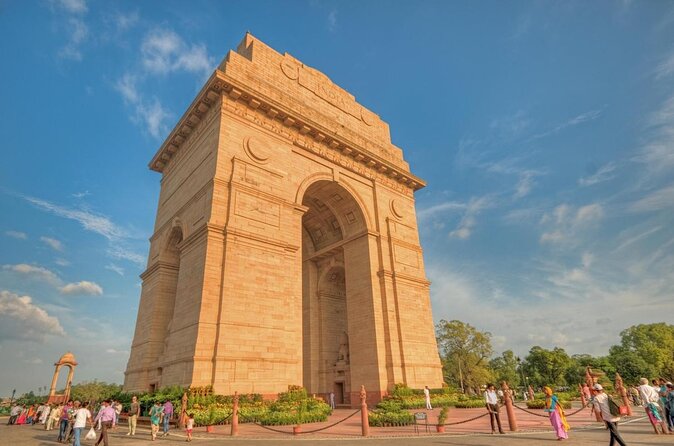
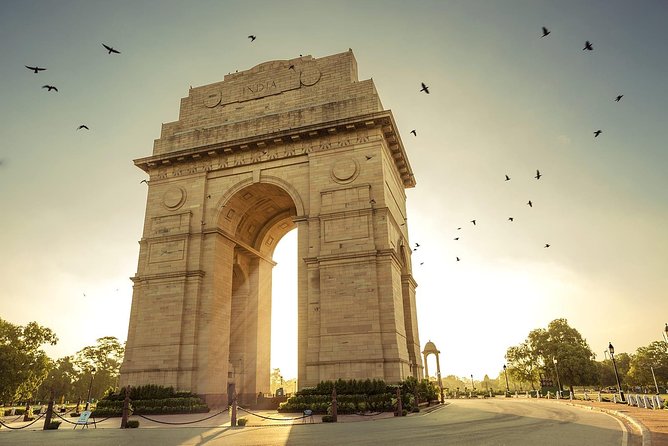
Later in Delhi, you’re set up for a classic imperial-and-republic contrast. You’ll visit the Lutyens-designed 42 m memorial arch on Rajpath area, built in 1921 and honoring around 90,000 Indian soldiers who died in World War I-related campaigns and conflicts like the 1919 Anglo-Afghan War. It’s a striking monument because it’s solemn, but also very “designed,” the kind of stonework that rewards a slower glance.
Then there is a stop for Rashtrapati Bhavan (President House), the official residence of the President of India. The scale is hard to miss in the details: the complex is described as having 340 rooms and about 2.5 km of corridors. Even if you only get a peek and not a full tour of interior spaces, it’s one of those stops that makes modern India’s governance feel real, not abstract.
If you’re short on time in Delhi and want fewer random stops, this segment is a solid use of an afternoon.
A few more New Delhi days to compare
- Old & New Delhi City Tour – Half or Full Day Options Available
★ 5.0 · 4,811 reviews - Half Day Private Delhi City Tour
★ 5.0 · 4,474 reviews - Same Day Taj Mahal, Agra Fort & Baby Taj Tour from Delhi by Car
★ 5.0 · 4,304 reviews - Taj Mahal Day Tour from Delhi by Superfast Train – TOP RATED TOUR
★ 5.0 · 4,166 reviews
How the Agra transfer sets up your sunrise Taj Mahal
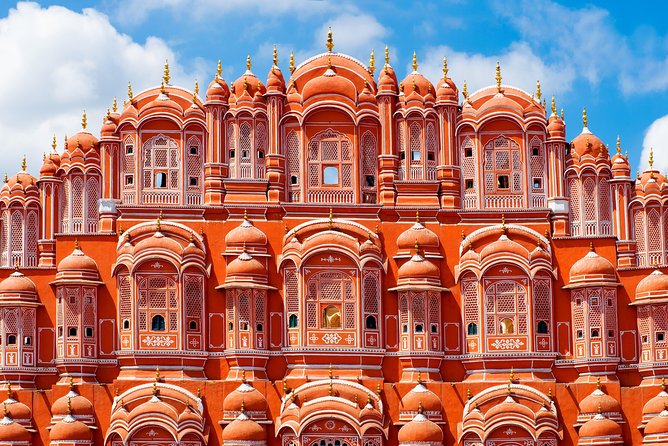
In late afternoon, you drive from Delhi to Agra, about three hours, and check into your hotel. This is a smart move because it positions you for an early next-day start. You also get time to reset before the big moment.
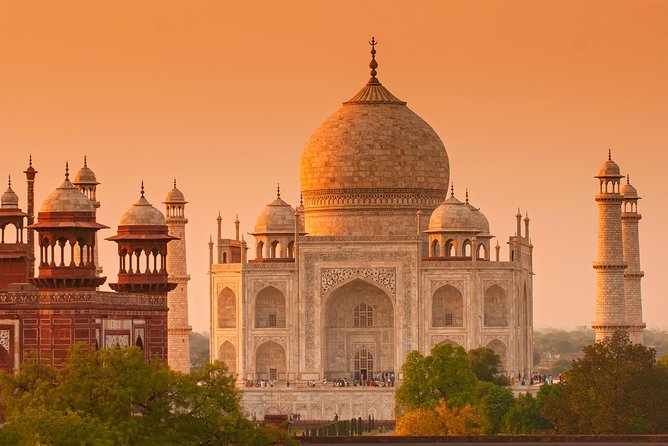
Then on day two, the tour hits Taj Mahal at sunrise. The famous part is obvious, but what you’re really paying for is the timing. Sunrise light changes the experience, and the earlier slot generally helps you avoid the worst of the peak crowd surge. You’re also given battery bus or golf cart return ride from parking to the Taj Mahal area, which is a small thing until you’re standing under the sun and want your legs back.
The Taj Mahal facts you’ll hear during the visit matter for how you look at it. It was built by shah Jahan as a memorial for Mumtaz Mahal, who died in 1631. The tour structure pushes you to see it as a crafted story, not just a photo backdrop.
Agra Fort: the Mughal power base beyond the postcard
After breakfast and checkout on the Agra day, you move to Agra Fort, another UNESCO World Heritage site along the Yamuna River. This one is a reminder that Mughal power lived in more than just royal tombs. The fort served as the main residence of Mughal emperors until 1638, and it’s described as among the finest Mughal forts.
Admission is included, and the time you get here is enough to notice details like how the fort’s design supports both defense and daily life. It’s also a useful contrast to the Taj Mahal. One is about memory and love, the other is about authority and control.
If you only see one Mughal site in Agra besides the Taj, I’d still argue Agra Fort is the better “how it worked” stop. The Taj Mahal can leave you speechless. The fort leaves you thinking.
Jaipur arrives after the long drive, and it hits fast
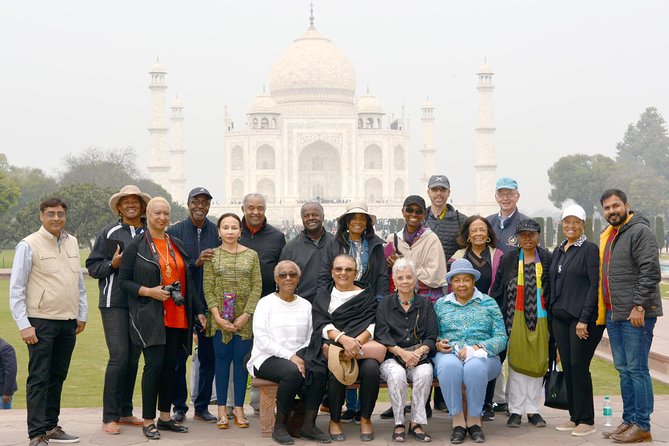
Later, you drive about five hours to Jaipur and check in. Jaipur is called the Pink City, and even without a deep dive into neighborhood corners, the timing helps. You’re not trying to do everything the same day you travel.
Once you’re in Jaipur, the tour leans into big hitters with Amer Fort first. After breakfast and checkout, you head to the honey-colored sandstone and marble complex described as an ethereal example of Rajput architecture rising from a rocky mountainside about 11 km northeast of Jaipur.
Amer Fort is split into multiple main sections, each with its own courtyard. That means you are walking through different “chapters” instead of just viewing one wall. Admission is included, and the time is set so you can see enough without feeling rushed.
Jal Mahal photo stop, short and oddly satisfying
Next up is Jal Mahal, the Water Palace. You get a photo stop only, with a note for panoramic views. The origins are said to be uncertain, though it’s believed to have been restored extensively, and maybe even built by jai Singh II around 1734.
This stop is a good example of why the tour structure works. You get the payoff of a famous visual without consuming half the day. If you like photos, the reflection-in-water look is what you’ll remember. If you hate sitting around, you can enjoy that it’s brief.
Hawa Mahal and the City Palace, Jaipur’s royal show
After Jal Mahal, you visit Hawa Mahal (Palace of Winds). It’s Jaipur’s most distinctive landmark, a five-storey honeycombed facade built in 1799 by Maharaja Sawai Pratap Singh. The purpose matters: it was designed so women of the royal household could watch city life and processions.
This stop is usually most fun when you approach it like a puzzle. Why that honeycomb pattern? How would it work for viewing? The tour format gives you time to take in the details instead of just passing by.
Then you move to the City Palace of Jaipur, the royal family’s residence area. The complex of courtyards, gardens, and buildings is in the center of the Old City. You’ll hear how it blends Rajasthani and Mughal architecture, and that you’ll see buildings from different eras, including some dating into the early 20th century.
If you want Jaipur to feel like a living place rather than just a set of walls, City Palace is where that clicks.
Jantar Mantar Observatory, geometry with a purpose
The tour ends this sightseeing run with Jantar Mantar, a UNESCO World Heritage site. It’s a collection of geometric structures built to track and monitor movements of stars and planets, with careful calibrations.
This is one of those stops that can feel strange if you treat it like a museum only. But it becomes engaging if you ask how humans once measured the sky using fixed instruments. The time allowed is about right for this kind of site, giving you enough attention without turning it into a chore.
Private logistics that matter: timing, guides, and comfort
On paper, this tour is “Delhi, Agra, Jaipur.” In practice, what you’re really buying is stress control. The tour includes a private driver and an air-conditioned vehicle, plus bottled water. That matters on long transfer days and especially when the weather turns warm.
It’s also built around private guides for the excursions. In feedback about GeTS Holidays, I’ve seen consistent praise for people like Azhar, Nishant, Santosh, and Deepak handling planning and responses, and guides like Nishant and Umesh Mall being the on-the-ground storytellers. I’ve also seen names of drivers mentioned for safe, timely driving, including Bobby, Pramod, and Yadov. Even if the exact roster changes, the pattern is clear: the company staffs the trip so you are not alone trying to interpret signs and crowds.
One practical tip: go into this knowing you will spend meaningful chunks of time traveling between cities. The payoff is you keep a full sightseeing day in each location instead of stretching your trip.
Price and value: what $412 includes, and what you’ll still pay
At $412 per person, this tour is priced like a bundle. You get 2 nights of hotel on twin or double sharing with breakfast, a private AC driver, professional private guides, and monument entrance fees. The Taj Mahal parking ride (battery bus or golf cart return) is included too, which quietly saves energy and time.
You also get bottled water, plus taxes and handling charges are included. That reduces the odds of surprise add-ons.
What’s not included is equally important. You’ll need to budget for lunch and dinner, plus camera fees at monuments (if charged), and gratuities. The tour is also listed as non-refundable and non-changeable, so you should only book if your dates are solid.
If you’re comparing value, think about the cost of building this yourself: a driver across three cities, entrance fees for multiple UNESCO sites, and guiding time. Doing it all at once, with transfers handled, is where this package tends to make sense.
Who should book this tour
This private Golden Triangle tour is a great fit if you:
- Want the big-name sights without planning headaches
- Prefer private guiding over a shared group scramble
- Like having breakfasts handled, and a hotel choice from 4-star or 5-star
- Are okay with early mornings and transfer days for the sake of covering Delhi, Agra, and Jaipur
It’s less ideal if you:
- Hate long car rides and want lots of free unstructured time
- Are very sensitive to schedule changes (the tour timing is clearly built around fixed sight slots)
Should you book it? My decision guide
If your goal is a classic Golden Triangle intro done the efficient way, I’d book this. The biggest reason is that it includes what usually becomes messy on your own: private transport, private guides, and the entrance fees for the key UNESCO sites. The sunrise Taj Mahal plus the golf cart or battery bus ride from parking is a smart combo for comfort.
Before you decide, check your travel day for Lotus Temple being closed on Mondays, and plan meals and cash for lunch, dinner, and any camera fees. Also be honest with yourself about driving time. This is a packed 3 days, not a slow, wandering country ride.
FAQ
What cities are included in this Golden Triangle tour?
This private tour covers Delhi, Agra, and Jaipur.
How long is the tour?
It runs for about 3 days.
Is pickup included, and what time does it start?
Pickup is offered, starting at 9:00 am from your desired location in Delhi, Gurugram (Gurgaon), or Noida.
What does the price include?
The package includes 2 nights of accommodation with breakfast, a private driver with an air-conditioned vehicle, professional private tour guides, monument entrance fees, battery bus or golf cart return ride from parking to the Taj Mahal, bottled water, and taxes and handling charges.
Are lunch and dinner included?
No. Lunch and dinner are not included. Breakfast is included for two days.
Can I choose between 4-star and 5-star hotels?
Yes, the tour offers an option to book 4 star or 5 star accommodation with daily breakfast.
Are the monument entrance fees included?
Yes. Entrance fees are included for the monuments listed in the program. Camera fees at monuments are not included.
Is Lotus Temple open on all days?
No. The Lotus Temple is closed on Mondays.
Is this tour private or shared?
This is a private tour/activity. Only your group participates.
What is the cancellation policy?
The experience is non-refundable and cannot be changed for any reason.
Recently added around New Delhi
- Private Same day Jaipur Tour from New Delhi★ 5.0 · 82 reviews
- Private Agra Day Tour★ 5.0 · 14 reviews
- Taj Mahal,Agra fort and Baby Taj tour from Delhi by Express train★ 5.0 · 7 reviews
- From Delhi: Full Day TajMahal & Agra Fort with 5 Star Lunch★ 5.0 · 64 reviews
- Taj Mahal & Agra City Private Tour from Delhi by Car – Fast Entry★ 5.0 · 13 reviews
- All Inclusive: Same day Taj Mahal Tour From Delhi★ 5.0 · 111 reviews
- Same Day Tour of Taj Mahal with Our Real Historical Experience★ 5.0 · 42 reviews
- Same Day Agra/Taj Mahal Tour from Delhi : Private & all inclusive★ 5.0 · 38 reviews
Golden Triangle Tours, compared.

3-Days Private Golden Triangle Tour: Delhi, Agra & Jaipur by Car
Read our review →3-Days Private Golden Triangle Tour: Delhi, Agra & Jaipur by Car
Read our review →
3-Day Delhi, Agra and Jaipur Private Tour – India Golden Triangle
Read our review →
Four-Day Private Luxury Golden Triangle Tour to Agra and Jaipur From New Delhi
Read our review →
5 Nights 6 Days Private Golden Triangle Tour – Delhi Agra Jaipur
Read our review →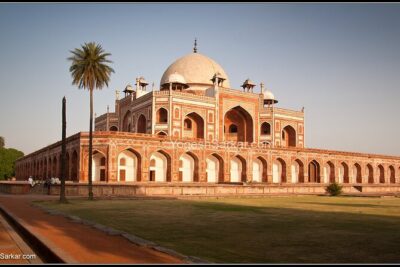

Private Car and Drive for Golden Triangle (4N/5D)
Read our review →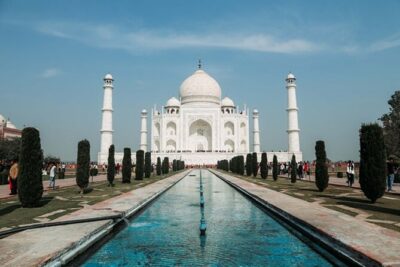
Private Golden Triangle Tour Delhi Agra Jaipur ( Top Rated )
Read our review →Browse the lists this tour appears in