
Reviewed · FATEHPUR SIKRI TOURS
Agra To Jaipur Drop Via Fatehpur Sikri & Chand Baori, Step Well
Two UNESCO stops, one easy ride. This private, air-conditioned transfer from Agra to Jaipur packs Fatehpur Sikri and the Chand Baori stepwell into one day, with tickets and guide help built in.
I really like the English-speaking guided time at Fatehpur Sikri, where you can actually make sense of what you are seeing across gates, halls, and courtyards. I also like that entry to Chand Baori is included, so you are not scrambling for tickets while you are trying to enjoy the views and the famous symmetry.
One drawback to plan for: English support can vary, especially with the driver. Fatehpur Sikri is covered with English-speaking guidance, but the rest of the day can depend more on who you meet and how busy it is.
In This Review
- Key highlights to know
- Why this Agra to Jaipur transfer feels worth it
- Fatehpur Sikri, the Mughal capital you can actually understand
- Shahi Darwaza Gate, the royal entrance
- Turkish Sultana’s House and Mughal mixing
- Panch Mahal and the idea of layered royal relaxation
- Buland Darwaza, Akbar’s monumental statement
- Diwan-i-Aam and Diwan-i-Khas, public vs private authority
- Hathi Pol and Hiran Minar, elephants as symbolism
- Birbal Bhavan and the smaller-scale carvings
- Tomb of Sheikh Salim Chishti, white marble focus
- Jama Masjid and the scale of worship
- Jodha Bai’s Palace and Diwan-i-Khas connections
- Anup Talao and Khwabgah, leisure and private reflection
- Chand Baori stepwell, where goats and steps steal the show
- Practical walking advice (yes, footwear)
- How to get better photos in less time
- Transport, timing, and what private really means
- The sedan size question
- Driver style and safety
- Guides and English support, what is guaranteed vs what to expect
- If you want an easy day, watch for the guide handoff
- Food, breaks, and how to avoid the lunch trap
- Value check: what you get for $146.06 per group
- Practical tips so your day stays smooth
- Should you book this tour?
- FAQ
- FAQ
- Is this tour private?
- How long does the experience take?
- Where can I be picked up in Agra?
- Is Fatehpur Sikri guided, and in English?
- Are entry tickets included?
- Is food included?
- What is the cancellation policy?
- Is there a mobile ticket?
Key highlights to know
- Private Agra pickup and Jaipur drop at hotels, stations, airport, restaurants, or your address
- Fatehpur Sikri guided access in English across major monument areas
- Chand Baori admission included and timed for a focused stop
- Low-stress handoffs between your driver and on-site guides
- Footwear matters on stepwell steps, and yes, there can be goats nearby
- Food is on your own, so choose your lunch stop instead of feeling trapped
Why this Agra to Jaipur transfer feels worth it
This is not just a “transfer.” It is a structured day with a private car and two major heritage stops in the right order. You get the comfort of a driver staying with your vehicle and your bags while you walk, and you get guided time at Fatehpur Sikri so the monuments do not turn into random big ruins.
The value is in the mix: you are paying for transportation plus guided sightseeing, and you also get admission built into the stops. For $146.06 per group up to 2, it is often a better deal than trying to piece together transport, guide, and tickets on your own across cities.
The day runs about 8 hours total, which is long enough to feel like you did something meaningful but not so long that it turns into pure fatigue. Still, it is a full day in the heat of North India, so plan for water, sun protection, and quick breaks.
Fatehpur Sikri tours readers book most in Agra:
- Private Transfer Agra to Jaipur with Fatehpur Sikri
★ 5.0 · 135 reviews - Private Transfer From Agra To Jaipur with Fatehpur Sikri
★ 5.0 · 117 reviews - Agra: Guided Tour of Taj Mahal, Agra Fort and Fatehpur Sikri
★ 4.7 · 81 reviews
Fatehpur Sikri, the Mughal capital you can actually understand
Fatehpur Sikri is one of those places where it helps to have someone explain the logic of the layout. With a guide covering the major areas in English, you can connect structures to people and purpose instead of just photographing stones.
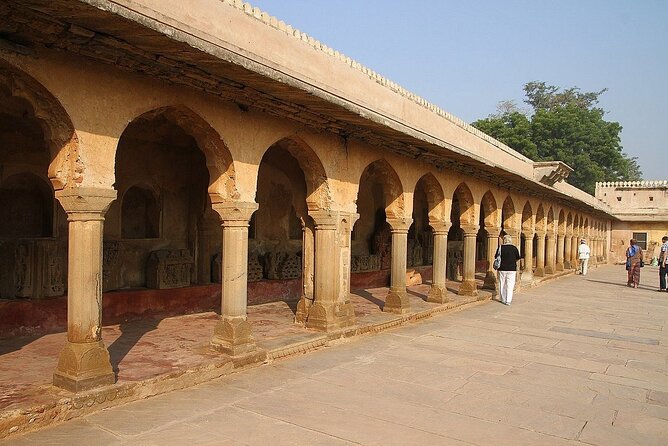
Here are the stops that make the visit feel complete. Expect a walking loop through the Mughal-era city with a strong focus on the grand entrances, royal spaces, and religious monuments.
Shahi Darwaza Gate, the royal entrance
The Shahi Darwaza Gate served as a ceremonial entrance for the emperor and court. It is the kind of structure where the scale and carving style tell you immediately this was meant for power display, not everyday traffic.
If you like architecture, this is a great starting point. You get your bearings fast, and you understand why the next gates and halls feel like different layers of authority.
Turkish Sultana’s House and Mughal mixing
This residence is built in an Indo-Turkish style, with elegant arches and decorative details. It is a good reminder that Fatehpur Sikri was not built in a single narrow lane. The court life here carried influences that showed up in design.
It also helps you shift from “monuments as objects” to “buildings as lifestyles.” A place like this makes the city feel human, even when most of what remains is stone.
A few more Stepwell tours around Agra:
- Agra to/from Jaipur with Chandboari Stepwell & Sikri Visits
★ 4.7 · 83 reviews - Private Transfer Agra To Jaipur Via Fatehpur Sikri & Chand Baori, Step Well
★ 5.0 · 39 reviews - Guided Fatehpur Sikri & Abhaneri Tour From Agra To Jaipur By Car
★ 4.5 · 17 reviews - Jaipur Amer Fort, Jal Mahal & Stepwell Private Half-Day Tour
★ 5.0 · 204 reviews
Panch Mahal and the idea of layered royal relaxation
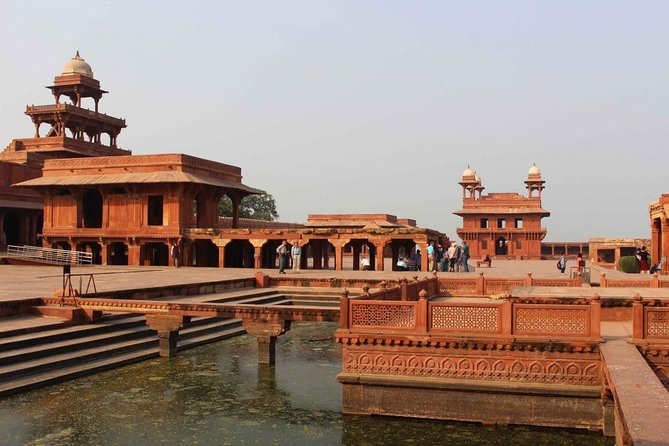
Panch Mahal is a five-story pavilion with open-pillared design, commonly used as a leisure space for royal women. Because the upper levels open out, you also get occasional breezes and wider views over the complex.
This is where you start noticing how the Mughal designers used height and openness to make spaces functional, not only decorative.
Buland Darwaza, Akbar’s monumental statement
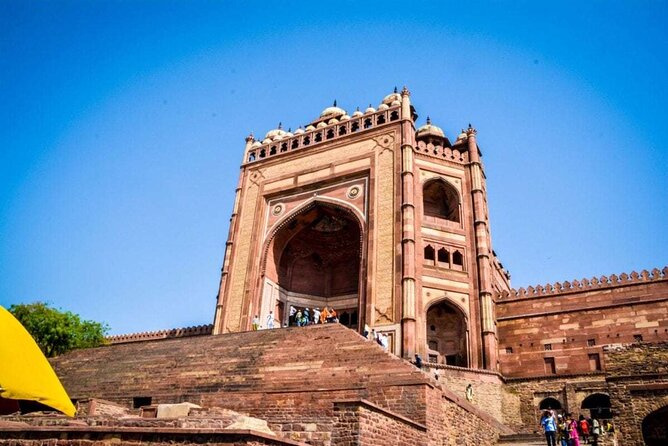
Buland Darwaza, built by Akbar in 1601, is a huge gateway celebrating victory over Gujarat. At about 54 meters high, it is meant to dwarf you and put the empire in your face, politely but firmly.
This is the stop where you should slow down. Look up at the proportions, then step back to see the gateway from a distance. That change in perspective is part of the experience.
Diwan-i-Aam and Diwan-i-Khas, public vs private authority
The Diwan-i-Aam was the hall of public audience where Akbar addressed grievances. The Diwan-i-Khas was for private audiences and discussions, known for its intricately carved pillar with radiating stone bridges.
Having both concepts in the same visit is powerful. You see how architecture supported two different kinds of rule, public theater and controlled access.
Hathi Pol and Hiran Minar, elephants as symbolism
Hathi Pol, the Elephant Gate, was designed wide and strong enough for royal elephants to pass. Nearby, Hiran Minar was built by Akbar in memory of his favorite elephant, with a purpose that makes it stand out from typical memorial towers.
If you enjoy odd details, you will like this pair. It turns the site from strictly political into personal symbolism.
Birbal Bhavan and the smaller-scale carvings
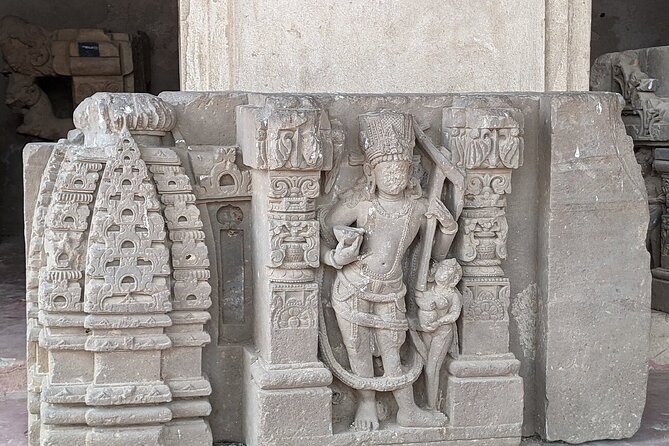
Birbal Bhavan near Jodha Bai’s Palace is known for elegant carvings and symmetrical design. It is also a good place to shift your attention from the biggest monuments to the craftsmanship of everyday royal life.
This stop helps you slow down and notice the quality of stonework.
Tomb of Sheikh Salim Chishti, white marble focus
The Tomb of Sheikh Salim Chishti is a beautiful white-marble structure with precious gems and stones as described in the tour details. Even if you are not religious, you can still feel the intention behind the design and decoration.
If you want less crowding and better photos, aim for early in the day if your schedule allows it.
Jama Masjid and the scale of worship
Jama Masjid at Fatehpur Sikri is one of the largest mosques in India, built by Akbar in 1571. It has intricate Persian-inspired motifs, and the scale is hard to grasp until you are standing near the main prayer areas.
This is a strong contrast from the palaces. It reminds you that Fatehpur Sikri was both political headquarters and spiritual center.
Jodha Bai’s Palace and Diwan-i-Khas connections
Jodha Bai’s Palace blends Rajput and Mughal styles with richly carved motifs and spacious courtyards. Nearby, the Diwan-i-Khas brings you back to the idea of controlled, private access to authority.
The combination helps you understand why the complex includes both cultural mixing and hierarchy in physical form.
Anup Talao and Khwabgah, leisure and private reflection
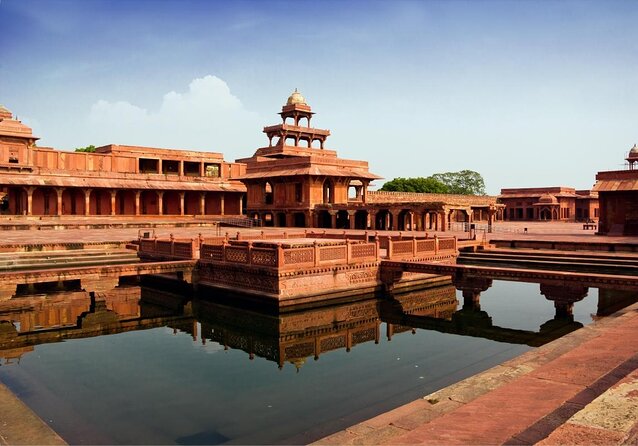
Anup Talao is an ornamental pool surrounded by pavilions, linked to music and gatherings. Khwabgah, or House of Dreams, is Akbar’s private chamber for rest and reflection.
These last stops are where the visit can feel less like a history lecture and more like a picture of daily rhythms in a royal setting.
Chand Baori stepwell, where goats and steps steal the show
Chand Baori, in Abhaneri, is famous for being one of the deepest and largest stepwells in the world, with origins described as over 1,000 years old. The tour keeps this stop focused at about 30 minutes, so you get enough time to walk the edges and soak up the symmetry without losing the whole day to the heat.
The big draw is the visual pattern. The layered steps pull your eye into the well like a geometric funnel. It is one of those places where a good angle matters more than extra time.
Practical walking advice (yes, footwear)
Bring proper footwear. The stepwell steps can be uneven, and you will want traction. One simple tip that makes a big difference: move slowly, take a breath, and pause for photos from a safe spot before you walk deeper.
Also, do watch for goats around the stepwell area. It is not a problem, just part of the real-life scene, and it helps to be alert rather than surprised.
How to get better photos in less time
Since your time here is short, think like a photographer, not a tourist. Start with wide shots for the full symmetry, then get close-ups of the step texture. If the sun is harsh, try changing your position to reduce glare.
You do not need to explore every corner to enjoy Chand Baori. You need to catch the geometry and feel the depth.
Transport, timing, and what private really means
You travel in a private air-conditioned vehicle, with pickup available from any location in Agra, including hotels, railway stations, airport, restaurants, or your chosen address. In Jaipur, the drop is just as flexible, including hotels, stations, airport, restaurants, or your preferred spot.
This is what private transfer should feel like: the day starts and ends where you need it to. It saves time, reduces stress, and keeps you from negotiating for taxis mid-day.
The sedan size question
A common consideration is luggage. You are traveling with two people, and the vehicle is described as a sedan for two people. That is usually fine, but if you carry a lot of bags, you may find the car feels tighter than expected.
The practical takeaway: keep luggage modest, especially if you are bringing more than about 5 bags. If you are traveling with extra big cases, mention it early so the vehicle choice can match reality.
Driver style and safety
Across the experience, the drivers are described as punctual, polite, and focused on safe driving. In many cases, the driver stays with the car and your luggage while guides handle the sightseeing stops.
That handoff approach is a big part of why this kind of trip works for people who want a “do the sites, skip the hassle” day.
Guides and English support, what is guaranteed vs what to expect
The tour details make one thing clear: for Fatehpur Sikri, you get entry ticket coverage and an English-speaking guide for all areas included in the planned visit. That means you should be able to understand the main structures and the key stories behind them.
At Chand Baori, the tour details specifically guarantee admission for the stop. Guide help may still be available on site, but based on actual experience patterns, guide quality can vary more here than at Fatehpur Sikri.
If you want an easy day, watch for the guide handoff
A smooth handoff matters. When your driver meets you and the guide arrives ready to start, you lose less time. One great Fatehpur Sikri guide name that comes up is Abid (Tony). If you are paired with someone like that, you will likely find the explanation style engaging and the walking plan logical.
For the drive itself, one driver name that came up is Govind, described as attentive and safe. Even if you do not get the same driver, the key is that the process should feel organized from pickup through drop.
Food, breaks, and how to avoid the lunch trap
Food and drinks are not included. That is normal for this kind of transfer, but it means your lunch stop is your responsibility.
Some tours end up with passengers funneling into a restaurant that the driver recommends, and that can lead to overpricing. The simple solution is to stay in control: when you get offered a lunch stop, choose where you eat based on your comfort and price range.
Also, drink water before you feel thirsty. In a full day with two major heritage sites and a hot stepwell stop, hydration is not optional.
Value check: what you get for $146.06 per group
At $146.06 per group up to 2, you are paying for:
- Private AC transport from Agra to Jaipur
- Entry coverage and English-speaking guided visiting at Fatehpur Sikri
- Admission included for Chand Baori
- A planned schedule that keeps the day moving without you coordinating separate tickets
If you tried to do this alone, you would spend time finding a driver, negotiating stops, lining up a guide at Fatehpur Sikri, and buying tickets. Even when you find good independent options, the coordination load can eat up your energy, especially when you are crossing a city-to-city route.
This tour is best value when you want a “one booking, done” day and you care about understanding Fatehpur Sikri. If your priority is wandering slowly and changing your own plan, you may feel the structure is limiting.
Practical tips so your day stays smooth
A few small choices make a big difference:
- Wear shoes or sandals with grip. Chand Baori steps need traction
- Carry a small bottle of water and sun protection
- Expect a full walking day at Fatehpur Sikri, with lots of gates and halls
- Keep luggage light if you want extra comfort in the sedan
- Plan your lunch yourself, because food is not included and you can choose where to stop
- If you are picky about language support outside Fatehpur Sikri, be ready to use simple questions and keywords
If the weather is hot, take your time at Anup Talao and Khwabgah type stops. Open spaces can be less intense in short bursts, then you push onward again.
Should you book this tour?
Book it if you want a private, organized Agra-to-Jaipur day that includes English-guided Fatehpur Sikri plus admission to Chand Baori without making you coordinate a bunch of parts. It is especially good if this is your only realistic time window to see these sites.
Skip or adjust expectations if you are traveling with a lot of luggage and expect a roomy car, or if you need constant English support at every stop. Fatehpur Sikri is the strong guided segment, while the Chand Baori experience can depend more on what guide support looks like on the day.
FAQ
FAQ
Is this tour private?
Yes. It is a private tour/activity, and only your group participates.
How long does the experience take?
The total duration is approximately 8 hours.
Where can I be picked up in Agra?
Pickup is available from any location in Agra, including hotels, railway stations, airport, restaurants, or your preferred address.
Is Fatehpur Sikri guided, and in English?
Yes. The visit to Fatehpur Sikri includes English-speaking guide tickets for the included areas.
Are entry tickets included?
Yes. Admission tickets are included for the tour stops, including Fatehpur Sikri areas and Chand Baori (Abhaneri) admission.
Is food included?
No. Food and drinks are not included.
What is the cancellation policy?
Free cancellation is available up to 24 hours in advance for a full refund. If you cancel less than 24 hours before the start time, it is not refunded.
Is there a mobile ticket?
Yes. The experience includes a mobile ticket.
Recently added around Agra
- Taj Mahal Half Day Tour by Tuk Tuk★ 5.0 · 16 reviews
- Day Trip Delhi to Agra by Express Train in 90 Min★ 5.0 · 43 reviews
- 3-Hour Unimaginable Beauty of Taj Private Guided Tour★ 5.0 · 13 reviews
- Taj Mahal Virtual Tour with Local Guide(Online Experience )★ 5.0 · 24 reviews
- Private Tour Guide For Taj Mahal And Agra Fort★ 5.0 · 17 reviews
- Taj Mahal by Tuk Tuk : A Local-Style Adventure★ 5.0 · 39 reviews
- Taj Mahal and Agra Full Day Private Tour From Agra★ 5.0 · 8 reviews
- Taj mahal Private Tour with Entry Ticket and Guide★ 5.0 · 42 reviews
Fatehpur Sikri Tours, compared.

Private Transfer Agra to Jaipur with Fatehpur Sikri
Read our review →
Private Transfer From Agra To Jaipur with Fatehpur Sikri
Read our review →
Guided Tour of Taj Mahal, Agra Fort and Fatehpur Sikri
Read our review →
Private Transfer From Jaipur to Agra including Fatehpur Sikri
Read our review →
Private Fatehpur Sikri Tour sightseeing All Inclusive
Read our review →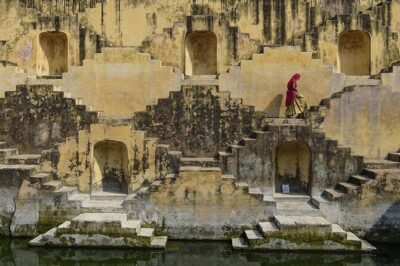
Private Transfer Agra To Jaipur Via Fatehpur Sikri & Chand Baori, Step Well
Read our review →
Browse the lists this tour appears in