
Reviewed · TAJ MAHAL TOURS
4 days Golden Triangle tour of Delhi, Taj Mahal in Agra & Jaipur with Guide
Golden Triangle tours live or die by the pacing, and this one is tight in the best way. You get a guided sweep through major World Heritage sights, from Qutub Minar in Delhi to the Taj Mahal in Agra, with Jaipur’s most famous forts and viewpoints in between. It also includes the practical stuff that matters, like a private car, entrance charges, and breakfast on three mornings.
Two things I really like: the time is structured so you do not waste half-days in transit, and the guide support makes the monuments much easier to understand. In the Delhi to Jaipur to Agra stretch, I also like that your driver and guide can keep things safe and comfortable, and adjust the day to family needs when needed, including when the guide is Balwinder and speaks fluent English.
One possible drawback: the schedule starts early, and it is a packed route. Also, a couple of Jaipur sights (like Jal Mahal and Hawa Mahal) do not have admission charges included, so you may want to budget for those extra tickets.
In This Review
- Key highlights worth planning for
- Price and Logistics: What You Really Pay For in the Golden Triangle
- Day 1 in Delhi: Qutub Minar, Iron Pillar, and a Mughal-Imperial Day
- Qutub Minar: Victory, empire, and one seriously tall minaret
- Iron Pillar: The mystery you can actually see
- Humayun’s Tomb: Mughal style as palace-like drama
- India Gate and Rashtrapati Bhavan: Memory and modern power
- Day 2 to Jaipur: Amber Fort Morning, Jal Mahal Pause, and Hawa Mahal Views
- Amber Fort: Red sandstone, marble details, and a defensible design
- Jal Mahal: The Water Palace that looks like it is floating
- Hawa Mahal: The honeycomb facade and the idea behind the windows
- City Palace: Mughal and Rajput fusion, plus courtyards and museum time
- Day 3 in Jaipur and Agra-Bound: Jantar Mantar’s Stone Sundial, then Fatehpur Sikri
- Jantar Mantar: 19 instruments built to correct astronomical tables
- Fatehpur Sikri: Akbar’s city with Persian design and mixed styles
- How to make this day work with energy
- Day 4 in Agra: Taj Mahal Scale, Materials, and a Return to Delhi
- Taj Mahal: 22 years of building, and materials from across the map
- The Guide and Driver Factor: Why Balwinder Makes This Run Feel Easy
- What This Tour Gets Right, and What to Watch
- What works extremely well
- What to watch before you book
- Who Should Book This 4-Day Guided Golden Triangle
- Should You Book This Tour?
- FAQ
- How long is the tour?
- Where does the tour take place?
- What is the meeting start time?
- Is pickup offered?
- Is this a private tour?
- What meals are included?
- Are entrance fees included?
- What major sights are visited?
- Is there a mobile ticket?
- What happens if weather is poor?
Key highlights worth planning for
- Early, efficient starts that keep you seeing monuments instead of sitting in traffic
- Entrance charges included for most major stops, plus breakfast on three mornings
- A guide who can translate the story behind each site, including strong English support from Balwinder
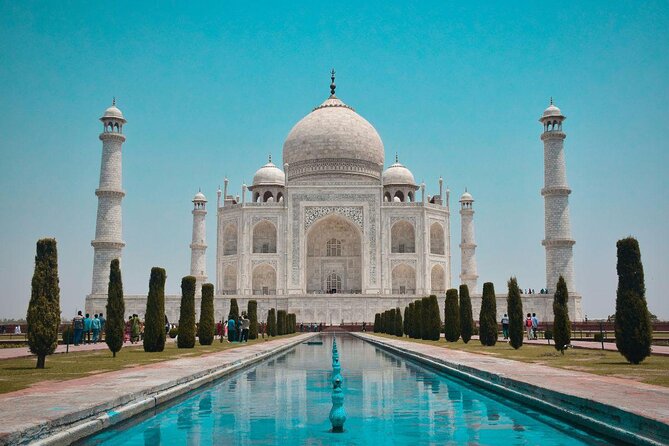
- Taj Mahal materials and scale details that help you read the building, not just photograph it
- Jaipur architecture stops that blend forts, royal palaces, and an 18th-century observatory
- Private car comfort on long drives between Delhi, Jaipur, and Agra
Price and Logistics: What You Really Pay For in the Golden Triangle
At $1,045.34 per person for about 4 days and 3 nights, this is not a bare-bones “hop on a bus” deal. You are paying for a private car, a guide, and entrance charges on the key sites, plus breakfast for three days. That combination matters on this route, because the Golden Triangle is a monument marathon where the biggest time-sink is usually logistics, not sightseeing.
Your day starts at 6:30 am, and that early kick is part of why the itinerary can fit so much in. You also get a mobile ticket, and pickup is offered, which helps when you are trying to stay calm in a big city like Delhi. Since it is a private tour for your group only, you are not negotiating with strangers about pace or bathroom breaks.
One more value signal: the tour is organized by Five Senses Tours, a private limited company recognized by the Ministry of Tourism and a member of IATO. That does not guarantee perfection, but it does usually mean you are dealing with a more established operator.
The “watch this” piece is simple. Food and beverages are not included. Also, not every Jaipur stop has admissions covered, so you may see small extra ticket costs when you arrive.
More Taj Mahal tours in New Delhi:
- Same Day Taj Mahal, Agra Fort & Baby Taj Tour from Delhi by Car
★ 5.0 · 4,304 reviews - Taj Mahal Day Tour from Delhi by Superfast Train – TOP RATED TOUR
★ 5.0 · 4,166 reviews - Full Day Taj Mahal, Agra Fort & Baby Taj Tour from Delhi by Car
★ 5.0 · 3,647 reviews
Day 1 in Delhi: Qutub Minar, Iron Pillar, and a Mughal-Imperial Day
Delhi on this route is built like a story, starting with early monumental power and ending with imperial-era landmarks. If you are new to Delhi, this first day helps you get your bearings fast, because each stop shows a different chapter of the city.
Qutub Minar: Victory, empire, and one seriously tall minaret
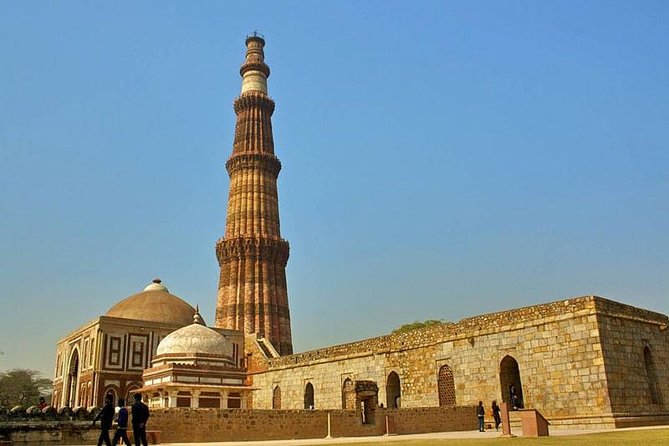
Your day begins at Qutub Minar, a tower whose origin is tied to Qutub-ud-din Aibak and Mohammad Ghori’s victory over Prithviraj Chouhan. The construction started in 1199 and was completed in 1236 by Iltutmish. What I like here is that you see a monument that is both symbolic and architectural, and you get the timeline without needing to study a textbook first.
The admission is included, and the stop is about one hour. That is enough time to take in the scale and details without feeling trapped in a line too long.
Iron Pillar: The mystery you can actually see
Next comes the Iron Pillar of Delhi, which is famous for one thing: it has survived for centuries with only a tiny amount of rust. The pillar is described as about 24 feet tall, weighing roughly 6 tons, and made from 98% wrought iron, built around 1,600 years ago. Even if you do not buy into every explanation, the result is still awe-inspiring. It is one of those monuments where the mystery is part of the attraction.
Plan about 45 minutes. Admission is included, so you are not juggling tickets on day one.
Golden Triangle tours readers book most in New Delhi:
- 3-Days Private Golden Triangle Tour: Delhi, Agra & Jaipur by Car
★ 5.0 · 1,107 reviews - 3-Days Private Golden Triangle Tour: Delhi, Agra & Jaipur by Car
★ 5.0 · 1,098 reviews - 3-Day Delhi, Agra and Jaipur Private Tour – India Golden Triangle
★ 5.0 · 812 reviews - Four-Day Private Luxury Golden Triangle Tour to Agra and Jaipur From New Delhi
★ 5.0 · 807 reviews
Humayun’s Tomb: Mughal style as palace-like drama
After that, Humayun’s Tomb shifts the mood. It is described as built like a palace rather than a burial tomb, and it is noted as one of the best preserved Mughal monuments and an early example of Mughal architecture in India. The fact that it is framed as architecture, not just a grave site, helps you see why it was influential.
You have around 45 minutes, and admission charges are included.
India Gate and Rashtrapati Bhavan: Memory and modern power
Then the route turns to landmark memorial space. India Gate commemorates soldiers who died fighting for the British Army during World War I, and the memorial bears names of more than 13,516 soldiers killed in the 1919 Afghan war. The stop is shorter, around 30 minutes, and that is fine because it is more about orientation and context than deep museum time.
Finally, you visit Rashtrapati Bhavan, the residence of India’s President, plus time in the Mughal Gardens. The gardens mix Mughal and English landscaping styles and highlight a variety of flowers. You get about 30 minutes here, which is a nice reset after earlier stone-heavy sights.
Day 2 to Jaipur: Amber Fort Morning, Jal Mahal Pause, and Hawa Mahal Views
By early day two, you are already doing the classic Golden Triangle move: leaving Delhi for Jaipur. The drive is scheduled for early morning, with departure at about 6:30 am and arrival around 10:30 am.
Jaipur is often hot, busy, and visually intense. What I like about this plan is it balances big fort energy with slower, scenic stops.
Amber Fort: Red sandstone, marble details, and a defensible design
Your first real Jaipur stop is Amber Fort and Palace, around 10:30 am. This is a major highlight, and it is not just because the walls look impressive. The fort is tied to Raja Man Singh I, who is credited with starting the construction of the red sandstone and white marble complex.
You will see defensive walls, plus the view from Maota Lake that creates a calmer backdrop. The stop is about one hour, and admission is included. If you only visit one major fort in Jaipur, make it this one.
A practical note: if you are sensitive to walking on uneven ground, give yourself some grace here. The fort layout is naturally more physical than the palace museum kind of stops.
Jal Mahal: The Water Palace that looks like it is floating
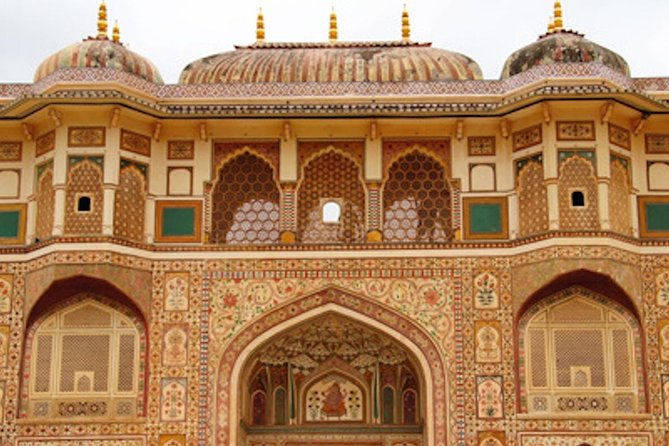
Next is Jal Mahal at Sagar Lake, around 30 minutes. This is one of those places where the value is the visual contrast: the pale sandstone palace shape against the deep blue water. The tour notes it as a former shooting lodge for the Maharajah, and that detail helps you understand why it is built like a pause point, not a full-time residence.
Admission is not included here, so plan for an extra ticket if you want to go inside. Even if you do not, you can still take in the view from outside, because that is the point.
Hawa Mahal: The honeycomb facade and the idea behind the windows
Then comes Hawa Mahal, also around 30 minutes. Built in 1798 by Maharaja Sawai Pratap Singh, it is described as a five-storey facade in honeycomb form, with 953 small windows called jharokas. The building is linked to the crown of Lord Krishna, and the tour explains that the windows were designed to help keep air moving so the palace stays cooler.
Admission is not included for this stop. Still, this is one of the best photo opportunities on the route because the facade is so distinctive. If you are trying to avoid crowds, timing matters. Arrive with patience, take the photos you want, and then keep moving.
City Palace: Mughal and Rajput fusion, plus courtyards and museum time
Your last Jaipur stop is City Palace of Jaipur, about one hour, with admission included. The palace is credited to Maharaja Sawai Jai Singh II, and you get a mix of Mughal and Rajput architecture plus gardens, courtyards, a temple, and a museum area.
This is a good place to slow down slightly, because palace spaces tend to let you look longer at smaller details. If you only have a single hour, focus on how the complex is arranged around courtyards and sightlines.
Day 3 in Jaipur and Agra-Bound: Jantar Mantar’s Stone Sundial, then Fatehpur Sikri
Day three is another pivot day. You start with an astronomy stop and end at an ancient city built by Akbar.
Jantar Mantar: 19 instruments built to correct astronomical tables
Your morning ends at Jantar Mantar, scheduled for about 10:30 am. This is an 18th-century astronomical observatory built by Sawai Jai Singh in 1730. The complex includes 19 architectural astronomical instruments, created to help correct astronomical tables for planetary positions.
The highlight is the Smarat Yantra, described as the world’s biggest stone sundial. That phrase is big, but the point for you is practical. When you stand there, you can see that the place is not just for show. It is built for measurement.
Admission is included, and you have about one hour.
Fatehpur Sikri: Akbar’s city with Persian design and mixed styles
Then you depart by road to Agra at about 11:00 am, arriving at about 2:00 pm for Fatehpur Sikri. This is a magnificent ancient city near Agra, built by Akbar. The tour notes Akbar’s inspiration from his ancestor Timur’s Persian courts, which shows up in Persian design principles. Architecturally, the red sandstone structures also include elements described as Hindu and Jain styles.
This stop is scheduled for about one hour, and admission is listed as free. That makes the value strong, because you get a major “wow” site without extra ticket cost.
How to make this day work with energy
Jantar Mantar plus Fatehpur Sikri is a smart pairing, but it is still a long day. If you are traveling with older family members, prioritize comfortable shoes and plan to take breaks. The tour’s structure is already efficient, but you will still want water and simple pacing.
Day 4 in Agra: Taj Mahal Scale, Materials, and a Return to Delhi
Day four is the payoff. You go straight to Taj Mahal, and it is scheduled as a main stop, with your drive back to Delhi later.
Taj Mahal: 22 years of building, and materials from across the map
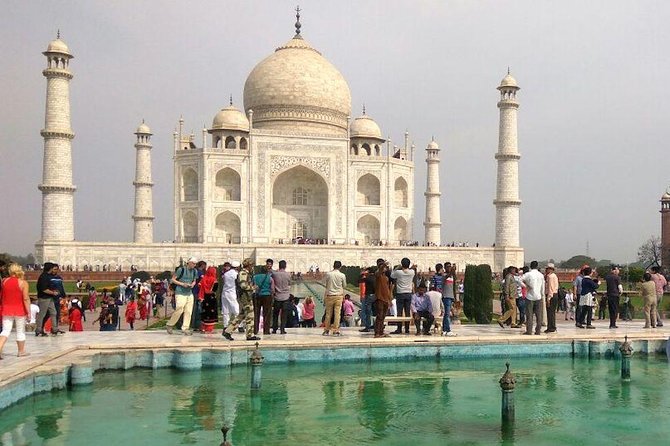
The Taj Mahal was built over 1631 to 1653, about 22 years. It was commissioned by Shah Jahan for his wife Mumtaz Mahal, who passed away during childbirth of their 14th child, according to the tour information.
The scale is explained through the supply chain too. The tour notes materials and labor came from many places across India and Asia: red sandstone from Fatehpur Sikri, jasper from Punjab, jade and crystal from China, turquoise from Tibet, plus lapis lazuli and sapphire from Sri Lanka. It also mentions 20,000 workers, sculptors from Bukhara, calligraphers from Syria and Persia, and stone cutters from Baluchistan.
Why this matters for you: Taj Mahal can feel like one big photo moment if nobody helps you read it. With these details in mind, you can start looking for patterns, craft work, and material changes instead of only chasing the postcard angles.
Admission is included, and after your Taj time you return to Delhi by car. The drive back is about one hour 30 minutes.
The Guide and Driver Factor: Why Balwinder Makes This Run Feel Easy
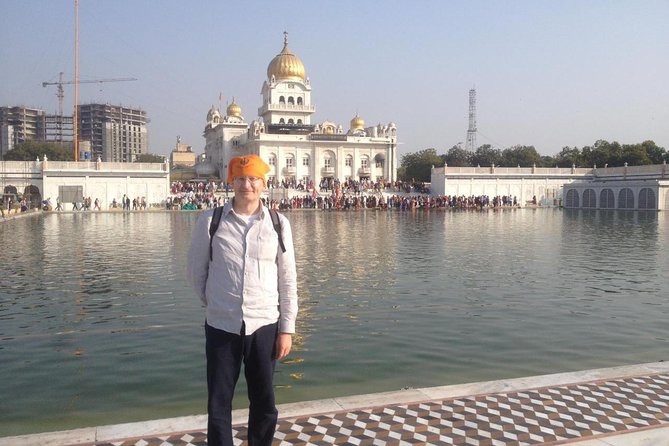
This tour has a simple superpower: practical guide support. In the comments you shared, the strongest praise centers on safety, comfort, and flexibility, and the name that pops up is Balwinder.
From a traveler’s point of view, an excellent driver and guide do three things:
- They keep you moving on schedule without making you feel rushed.
- They answer questions in plain language, so monuments stop being confusing walls.
- They adjust when your group needs changes.
In your case, that matters most because the route has a lot of early starts and switching cities. If you are with family, you want someone who can adapt the pace to your needs. The guide support being in strong English also helps you ask follow-up questions and get meaningful context without straining.
What This Tour Gets Right, and What to Watch
What works extremely well
You are getting a well-rounded Golden Triangle in a short window. Delhi gives you early and imperial-era landmarks, Jaipur brings major fort and palace architecture plus the astronomy angle, and Agra caps it with the Taj Mahal. Because admission charges are included for many stops, you do not constantly calculate ticket hassles.
I also like the way the stops vary. You go from minaret and ironwork to tomb gardens and memorial spaces. Then you switch to Rajasthan forts and palaces, then return to monument scale with Akbar’s city and the Taj.
What to watch before you book
Two things to keep in mind:
- A packed schedule. You will be on the go. If you prefer slow travel, this might feel like nonstop sightseeing.
- Some Jaipur admissions are not included. Jal Mahal and Hawa Mahal are listed as admission not included. If you care about entering those sites, factor that cost in.
Who Should Book This 4-Day Guided Golden Triangle
This tour is a strong match if:
- You want the Golden Triangle highlights without building your own plan from scratch.
- You value a guide who can help you understand what you are seeing and keep you comfortable between cities.
- You like structure, early starts, and a clear sequence of stops.
It may be less ideal if:
- You want lots of free time in each city.
- You strongly prefer fewer stops and longer stays, especially in Delhi and Jaipur where the days move quickly.
Should You Book This Tour?
If your goal is to check off Delhi, Jaipur, and Agra’s big monuments with a guide, a private car, and entrance charges handled, I think this is a solid booking. The price can look steep until you realize how much is covered: private transport, guide time, entry fees for most major sights, and breakfast for three mornings.
If you are the type who hates surprises, note the two Jaipur sites with admissions not included. And if you need a slow rhythm, be aware that the early start style of this itinerary will feel busy.
If that sounds like your pace, book it. You will come away with a cleaner picture of how these three cities connect, and with enough guide context to make the Taj Mahal and the Jaipur architecture more than just photos.
FAQ
How long is the tour?
It runs for about 4 days and 3 nights.
Where does the tour take place?
The tour is based in New Delhi and includes Delhi, Agra, and Jaipur.
What is the meeting start time?
The start time is 6:30 am.
Is pickup offered?
Yes, pickup is offered.
Is this a private tour?
Yes, it is a private tour/activity, and only your group will participate.
What meals are included?
Breakfast is included for 3 mornings. Food and beverages are not included otherwise.
Are entrance fees included?
Entrance charges are included for most listed stops, but admission tickets are not included for Jal Mahal and Hawa Mahal.
What major sights are visited?
The tour includes Qutub Minar, Iron Pillar of Delhi, Humayun’s Tomb, India Gate, Rashtrapati Bhavan, Amber Fort, Jal Mahal, Hawa Mahal, City Palace, Jantar Mantar, Fatehpur Sikri, and the Taj Mahal.
Is there a mobile ticket?
Yes, a mobile ticket is included.
What happens if weather is poor?
The experience requires good weather. If it is canceled due to poor weather, you will be offered a different date or a full refund.
Recently added around New Delhi
- Private Same day Jaipur Tour from New Delhi★ 5.0 · 82 reviews
- Private Agra Day Tour★ 5.0 · 14 reviews
- Taj Mahal,Agra fort and Baby Taj tour from Delhi by Express train★ 5.0 · 7 reviews
- From Delhi: Full Day TajMahal & Agra Fort with 5 Star Lunch★ 5.0 · 64 reviews
- Taj Mahal & Agra City Private Tour from Delhi by Car – Fast Entry★ 5.0 · 13 reviews
- All Inclusive: Same day Taj Mahal Tour From Delhi★ 5.0 · 111 reviews
- Same Day Tour of Taj Mahal with Our Real Historical Experience★ 5.0 · 42 reviews
- Same Day Agra/Taj Mahal Tour from Delhi : Private & all inclusive★ 5.0 · 38 reviews
Taj Mahal Tours, compared.

Same Day Taj Mahal, Agra Fort & Baby Taj Tour from Delhi by Car
Read our review →
Taj Mahal Day Tour from Delhi by Superfast Train – TOP RATED TOUR
Read our review →
Full Day Taj Mahal, Agra Fort & Baby Taj Tour from Delhi by Car
Read our review →
Taj Mahal & Agra Private Day Trip with Transfers
Read our review →
Taj Mahal Tour from Delhi by Express Train (Viator Award Winner)
Read our review →
All Inclusive Private Taj Mahal Luxury Tour from Delhi by Car
Read our review →
Same Day Taj Mahal, Fort & Baby Taj Tour from Delhi by Car
Read our review →
Browse the lists this tour appears in